Fragrance Notes Are Layers Of Scent That Are Layered To Form The Final Fragrance. Fragrance Notes Are Categorised Into Three Main Elements Based On How Long They Take To Evaporate, And How Long They Typically Last Following Application: Top Notes, Heart Notes And Base Notes.
Cashew
The cashew note in perfumery offers a rich, nutty aroma reminiscent of toasted popcorn, roasted almond, and hazelnut, often with a sweet, caramellic nuance. It can also exhibit woody, balsamic, and subtly spicy facets, sometimes presenting a creamy, slightly floral quality, making it versatile for gourmand and oriental compositions.

Origin & Extraction Of Cashew
Cashew, while not a classical note like rose or citrus, is a modern ingredient in perfumery, reflecting the late 20th and 21st-century trend toward gourmand and photorealistic "edible" fragrances. The cultivation and consumption of cashews date back centuries in Brazil, but the nut's distinctive toasted, sweet, and creamy aroma was not typically isolated or utilized in fragrance formulation until recent decades. Its relevance grew as perfumers sought complex, comforting sweetness that moved beyond traditional vanilla or simple sugar accords, integrating the rich, savory depth of toasted nuts into luxury compositions.
Today, the cashew note is typically a reconstructed accord, combining synthetic molecules to capture its profile, which includes facets of toasted popcorn, roasted almond, and caramel. It is used strategically in oriental and gourmand structures, where it provides a warm, unique textural element and enhances the longevity of surrounding sweet and woody base notes. While it lacks the historical prestige of foundational notes like Bergamot, Cashew represents sophistication in modern gourmands, signaling a fragrance designed for indulgent comfort and complex richness.
The extraction of oil from the cashew involves two distinct processes: the recovery of Cashew Nut Shell Liquid (CNSL) from the pericarp and the extraction of edible oil from the kernel. Historically, CNSL was removed through traditional roasting methods, such as open pan or drum roasting, where nuts were heated to 180–185°C. This process served the dual purpose of releasing the corrosive liquid and making the shells brittle for manual cracking. Another traditional approach for the kernel involved manual cold pressing or using small screw-type machines to squeeze the raw seeds, a method still used for artisanal, nutrient-rich oils.
Modern commercial extraction has evolved into more sophisticated mechanical and chemical systems. The most common industrial method today for CNSL is the hot oil bath process, while mechanical screw pressing (or cold extrusion) is used to quickly produce high-quality oil by applying intense pressure to raw shells. For high-purity applications, technical CNSL is refined through vacuum pyrolysis or molecular distillation to isolate specific compounds like cardanol. Recent advancements also include solvent extraction using Soxhlet apparatuses with hexane or pentane, and innovative green technologies like Supercritical Carbon Dioxide (SC-CO2) extraction and Polyol-Induced Extraction (PIE), which capture delicate aromatic and chemical profiles without the high heat or toxic solvents associated with traditional methods.
The Cashew note, with its distinctive aroma of toasted nuts, caramel, and creamy warmth, is a unique addition primarily found in modern niche and gourmand fragrances. While it is not a classic ingredient like Bergamot or Vanilla, it lends a sophisticated, comforting depth to scents that aim for an edible, rich quality. One notable example showcasing this rich nuttiness is **Cashew Gourmand** by a prominent independent house, where the note forms the creamy heart of the composition, blending seamlessly with sweet spice and woods.
- *
The complex profile of Cashew, often reminiscent of roasted almond or hazelnut, allows it to be strategically employed to enhance oriental and spicy compositions. In certain opulent perfumes, such as **Golden Nut Elixir**, Cashew provides a subtle, savory undercurrent that grounds the brighter opening notes. This effect adds texture and a layer of addictive warmth, distinguishing it from simpler caramel or vanilla accords.
- *
Due to its versatility in bridging sweet gourmand facets with subtle woody undertones, Cashew has also been adopted in experimental fragrance designs. For instance, **Urban Nut Tree** utilizes the Cashew note to evoke a natural, earthy setting alongside green and balsamic elements, offering a contemporary take on the nut accord that is both comforting and distinctly modern, showcasing its potential beyond pure edible fragrances.
Sustainability Of Cashew
Sustainability of Cashew
- Adopting regenerative agriculture practices like cover cropping, biochar application, and zero-tillage to restore soil health and sequester carbon
- Implementing water-efficient technologies such as drip irrigation and rainwater harvesting to manage high water requirements in tropical regions
- Transitioning to organic farming and natural pest management using neem oil and pheromone traps to eliminate synthetic chemical residues
- Promoting a circular economy by upcycling by-products, such as using cashew shells for biomass fuel or organic compost
- Ensuring social responsibility through Fair Trade certification, providing protective gear for workers, and establishing cooperatives to empower smallholder farmers
- Utilizing digital traceability tools and satellite monitoring to prevent deforestation and ensure transparent supply chains
Trivia
Botanically, the part of the cashew we eat is not actually a fruit but a pseudo-fruit or floral stalk, while the "real" fruit is the hard-shelled nut attached to the bottom.
Most Popular Scents Using Cashew
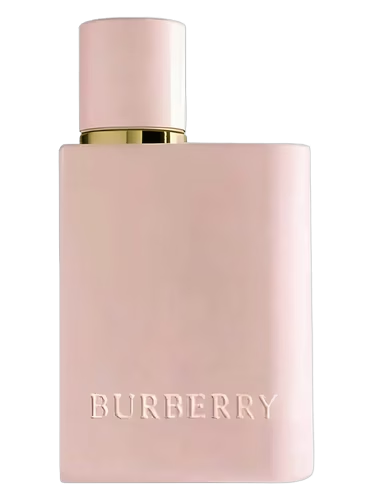

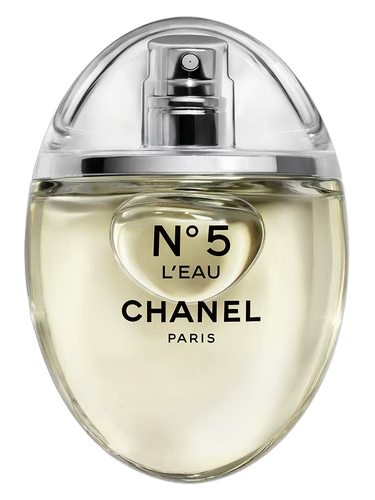
What is the cashew note in perfumery?
The cashew note is a modern gourmand ingredient used to provide a rich, toasted, and creamy aroma. In fine fragrance, it is typically a reconstructed fantasy accord rather than a natural extract.What does cashew smell like?
It offers a warm, buttery, and nutty scent reminiscent of roasted almonds or hazelnuts, often with sweet caramellic nuances and subtle woody or balsamic facets.How is the cashew note created?
Since there is no commercial essential oil from the nut, perfumers use synthetic molecules like pyrazines for nuttiness and lactones for creaminess to replicate the olfactory profile of a roasted cashew.What are some top perfumes featuring the cashew note?
Notable fragrances include Isolda Cajueiro, Epoque Tropical, Chokedee, and Madar.When is the cashew tree in season?
Seasonality depends on the hemisphere; it is typically harvested from January to June in the Northern Hemisphere (e.g., India, Vietnam) and from September to February in the Southern Hemisphere (e.g., Brazil).