Fragrance Notes Are Layers Of Scent That Are Layered To Form The Final Fragrance. Fragrance Notes Are Categorised Into Three Main Elements Based On How Long They Take To Evaporate, And How Long They Typically Last Following Application: Top Notes, Heart Notes And Base Notes.
Cannonball Flower
Cannonball Flower offers a unique, complex aroma, balancing its key natural compounds. It is often described as soft, solar, and fruity, with a subtle sweetness reminiscent of stretchy ice cream (booza) and a creamy floral nuance, similar to orange blossom water. It provides a unique, intriguing, and pleasant sensory experience.

Origin & Extraction Of Cannonball Flower
The Cannonball Flower (Couroupita guianensis), originating in tropical regions, has a history primarily rooted in cultural and religious significance, rather than classical Western perfumery. In Hinduism, the tree is considered sacred and is often planted near temples, with the unique fragrance and appearance of the flowers used as offerings to deities during pujas, symbolizing reverence and adoration.
While the flowers have been used historically in local cosmetics and perfumes in regions where the tree grows, its introduction as a distinct note in modern global fine perfumery is relatively niche. The fragrance note, described as soft, solar, and creamy-floral, is utilized today by contemporary perfumers seeking unique, complex, and intriguing exotic floral notes that balance sweetness and a unique sensory experience, moving beyond traditional floral ingredients.
Extraction Methods of Cannonball Flower
Historically, the aromatic and medicinal compounds of the cannonball flower (Couroupita guianensis) were obtained through traditional maceration and solvent extraction techniques. Fresh or shade-dried flowers were typically steeped in solvents like alcohol, methanol, or petroleum ether for extended periods at room temperature to capture their volatile oils and phytochemicals. Simpler methods such as infusion and boiling were also used to create aqueous extracts for traditional medicinal applications.
In modern practice, advanced techniques are employed to preserve the delicate fragrance profile and enhance yield. These include steam distillation and ultrasonic-assisted extraction, with the latter often found to be superior for recovering bioactive compounds. To capture the most accurate representation of the flower's live scent, researchers now utilize headspace-solid phase micro-extraction (HS-SPME) followed by GC-MS analysis. Additionally, green synthesis methods use flower extracts as reducing agents to create silver nanoparticles for specialized pharmacological applications.
The Cannonball Flower note, being relatively niche and exotic, is not widely featured in mainstream classic perfumery but is prized in contemporary artisanal and niche compositions where its unique, solar, creamy-floral, and subtly fruity profile is highlighted. Its inclusion signals a move towards unique and complex tropical notes, often replacing more common florals to create an intriguing signature.
- A significant example of a fragrance incorporating the Cannonball Flower, or an accord inspired by its unusual scent profile, is the niche brand's focus on exotic flora, such as in the creation **Tropic Bloom** by Niche Perfumery House. This fragrance utilizes the note to provide a creamy, sweet, and slightly spiced floral heart, grounding the bright tropical fruit notes while lending an unusual depth.
Due to the difficulty in extracting a natural oil from the fragile flower and the need to preserve the complex "stretchy ice cream" sweetness mentioned in its odor profile, the Cannonball Flower note is often recreated via high-quality synthetic accords. This allows perfumers to control the balance between the creamy orange blossom facet and the unique tropical fruit nuances, ensuring stability and projection. The resulting aroma works well in luminous, warm-weather scents, such as the limited edition summer release, **Exotic Couroupita**.
- Another notable usage can be found in the tropical collections of designer houses, such as the resort-exclusive line featuring **Paradise Bloom**. Here, the Cannonball Flower accord contributes a soft, solar warmth and a creamy texture, ensuring the fragrance feels enveloping and luxurious rather than simply sharp or green. It offers a subtle, sweet complexity that enhances the composition's overall tropical floral signature.
While specific mainstream commercial releases rarely explicitly name "Cannonball Flower" in their note pyramids, the complex scent profile—balancing creamy sweetness with a solar floral quality—is often woven into modern white floral or oriental structures. This subtle incorporation helps to modernize classic notes, giving the composition a unique, intriguing exoticism and a soft, pleasant sweetness that avoids traditional saccharine gourmand territory, appealing to collectors and connoisseurs of exotic scents like those found in the high-end creation **Temple Garden**.
Sustainability Of Cannonball Flower
Sustainability of Cannonball Tree
- Promoting biodiversity conservation by protecting the Couroupita guianensis, a member of the tropical rainforest community that provides essential habitat and food for monkeys, birds, and insects
- Supporting carbon sequestration efforts as the tree absorbs carbon dioxide, helping to mitigate climate change and improve air quality
- Implementing reforestation and conservation projects through partnerships with organizations like Grow Billion Trees to restore degraded landscapes and combat deforestation
- Engaging local communities and indigenous groups in stewardship initiatives and education on the ecological significance of native species and sustainable forestry practices
- Utilizing advanced technology such as drone mapping and satellite imagery to identify suitable planting sites and monitor the health of conserved trees
- Advancing corporate social responsibility (CSR) and ESG goals by integrating strategic tree planting to help organizations achieve net-zero targets and support sustainable development goals
Trivia
The cannonball tree is a rare example of flagelliflory, where its strongly scented flowers and massive 15-pound fruits grow directly from the trunk on tangled, vine-like stems rather than on branches.
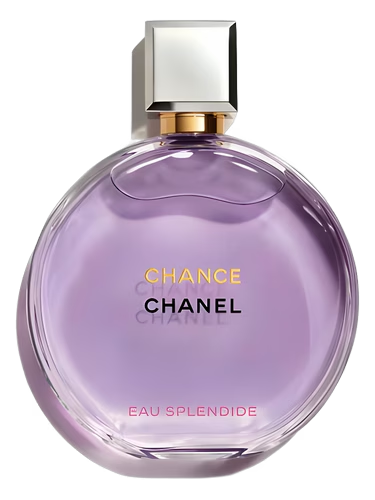
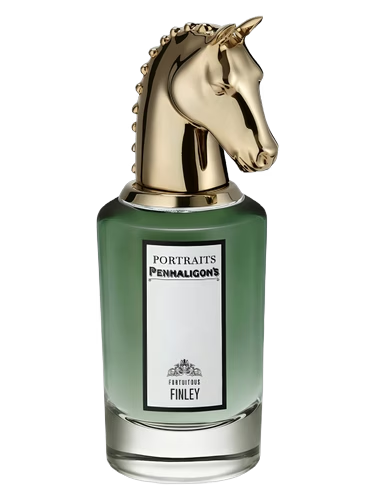
Most Popular Scents Using Cannonball Flower

What is Cannonball Flower?
The Cannonball Flower comes from the Couroupita guianensis tree, a tropical species native to Central and South America that is often planted near temples in India for its religious significance.What does Cannonball Flower smell like?
It offers a unique, solar, and creamy floral aroma with a subtle sweetness reminiscent of "stretchy" ice cream and facets of orange blossom water.How is Cannonball Flower essence extracted?
In modern perfumery, advanced techniques like steam distillation and headspace technology are used to capture its delicate scent, though historical methods involved maceration.What are some top perfumes featuring Cannonball Flower?
Notable fragrances include Pryn Parfum Morah, Scotch & Soda Island Water Woman, OsmoGenes Perfumes Royal Temptation, and Arquiste Ella.When is the Cannonball Flower in season?
In its native tropical habitats, the tree exhibits a year-round growth cycle, often blooming and producing fruit simultaneously throughout the year.