Fragrance Notes Are Layers Of Scent That Are Layered To Form The Final Fragrance. Fragrance Notes Are Categorised Into Three Main Elements Based On How Long They Take To Evaporate, And How Long They Typically Last Following Application: Top Notes, Heart Notes And Base Notes.
Camellia
Camellia is a fantasy floral note, prized for its sophisticated, delicate, and pure essence. It typically manifests as a soft, clean, and slightly powdery aroma, offering subtle elegance. While sometimes described as nearly odorless, in perfumery, it adds a nuanced, light-hearted floral touch to compositions, often blending seamlessly with white florals.

Origin & Extraction Of Camellia
The Camellia flower, known botanically as *Camellia japonica*, does not yield a natural essential oil through traditional extraction methods like distillation or solvent extraction, as the flower is largely scentless or the aroma is too faint to capture. Therefore, the "Camellia" note in perfumery is almost entirely a fantasy accord, meaning it is synthetically constructed by perfumers to evoke the *idea* of the flower—typically a soft, clean, delicate, and slightly powdery white floral scent. Historically, this meant that Camellia was not a part of classic perfumery structures, which relied on naturally extracted materials like Rose, Jasmine, or Bergamot.
Camellia gained relevance in fragrance primarily in modern perfumery, particularly in the late 20th and early 21st centuries, as synthetic chemistry expanded the palette of notes available to capture abstract or non-extractive scents. Its use is strategic: it often functions to add a sophisticated, pure, and light-hearted floral nuance, avoiding the heaviness of more traditional white florals. It is frequently associated with luxury brands like Chanel, which famously used the Camellia flower as a recognizable aesthetic symbol (though not always a dominant scent note), cementing its modern image as a scent of delicate, clean elegance.
Extraction Methods of Camellia
The extraction of camellia oil and essence is primarily achieved through mechanical pressing and solvent-based techniques. Traditionally, camellia seeds were processed using manual hot pressing, which involved drying the seeds, crushing them with heavy stones or manual mills into a paste, and steaming them before applying pressure to extract the oil. While this traditional method is still used in small artisanal workshops to maintain flavor, the high temperatures involved can sometimes lead to oxidation and a darker color.
Modern commercial production has shifted toward more efficient and specialized methods. Cold pressing is a preferred high-end technique where seeds are processed at temperatures below 60°C, preserving the oil's original nutrients, color, and delicate aroma. For industrial-scale yield, solvent extraction using light petroleum or alcohol is common, often involving a multi-step refining process. Recent advancements have introduced innovative green technologies such as supercritical CO2 extraction, ultrasound-assisted extraction (UAE), and microwave-assisted extraction (MAE), which allow for the capture of sensitive bioactive compounds like polyphenols and catechins with greater precision and lower environmental impact.
The Camellia note, being a fantasy accord rather than a direct extract, is often employed to suggest a sophisticated, clean, and delicate floral presence in modern perfumery, embodying the idea of elegance without the heaviness of traditional white flowers. This note aligns perfectly with the aesthetic of brands seeking purity and light-hearted freshness. A notable example that features this note prominently is **ELLA K Camelia K**, where the note is utilized to create a soft, pure floral heart.
Due to its association with delicate elegance, Camellia has often been tied conceptually to luxury fashion houses, most famously Chanel, where the Camellia flower is an iconic symbol. Although not always the dominant central note, the *idea* of Camellia influences the composition of certain fragrances, providing a subtle, refined, and slightly powdery floral background. This approach ensures the scent remains airy and sophisticated.
The note is prized for its ability to blend seamlessly, offering nuance rather than outright potency. Contemporary perfumers use Camellia to add a light, aqueous, and slightly green floral touch, often supporting brighter top notes or smoothing out the transition into musk or woods. This strategic use allows the Camellia accord to contribute a sense of clean, abstract luminosity to complex floral and chypre compositions.
Sustainability Of Camellia
Sustainability of Camellia
- Promoting a circular economy by utilizing organic composting and mulching with pine needles or leaf mold to recycle nutrients and improve soil fertility
- Adopting water-efficient cultivation through deep root establishment and organic mulching to enhance moisture retention and reduce irrigation needs
- Supporting land restoration and biodiversity by cultivating hardy species like Camellia oleifera to stabilize soil, prevent erosion, and rehabilitate degraded land
- Implementing integrated pest management and sustainable farming practices that minimize synthetic inputs and protect local ecosystems
- Fostering socio-economic resilience by creating jobs in rural communities for the harvesting and processing of camellia seeds and oils
- Preserving cultural heritage and biodiversity through the protection of ancient camellia trees and traditional management practices at historic sites
Trivia
The camellia was famously the favorite flower of fashion designer Coco Chanel, who chose the Alba Plena variety specifically because its lack of scent ensured it would never interfere with her own perfume, Chanel No. 5.
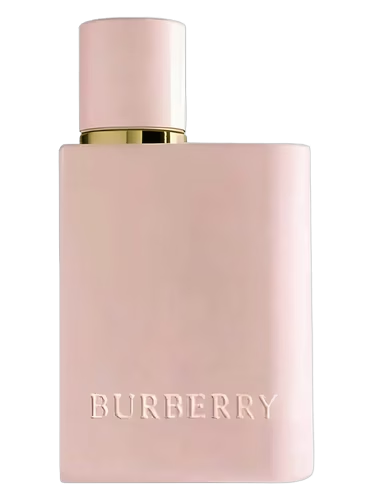
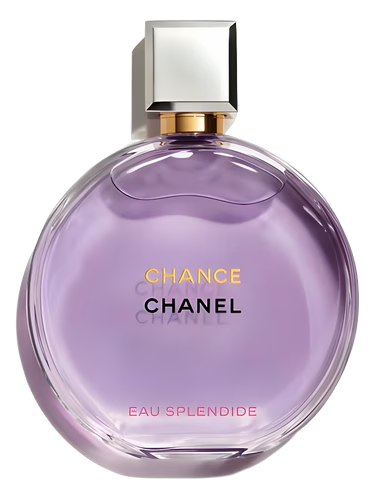
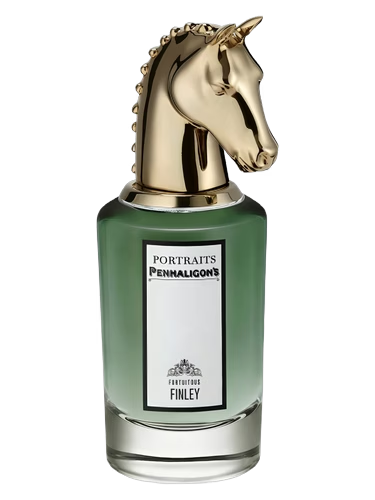
Most Popular Scents Using Camellia
What is Camellia?
Camellia is a fantasy floral note in perfumery, synthetically reconstructed to evoke the sophisticated, delicate, and pure essence of the largely scentless flower.What does Camellia smell like?
It features a soft, clean, and slightly powdery aroma with light-hearted floral touches and subtle aqueous or green nuances.How is Camellia essence extracted?
Because the flower produces no extractable aromatic material, the scent is created through synthetic accords, though odorless oil can be cold-pressed from the seeds for cosmetic use.What are some top perfumes featuring Camellia?
Notable fragrances include Acqua di Parma Camelia, Ella K Camelia K, Krigler Extraordinaire Camelia 209, and Chanel Une Fleur de Chanel.When is Camellia in season?
Camellia shrubs are known as the queens of winter flowers, with species like Camellia sasanqua blooming in fall and winter, while Camellia japonica peaks in early spring.