Fragrance Notes Are Layers Of Scent That Are Layered To Form The Final Fragrance. Fragrance Notes Are Categorised Into Three Main Elements Based On How Long They Take To Evaporate, And How Long They Typically Last Following Application: Top Notes, Heart Notes And Base Notes.
Buttercup
Buttercup offers a bright, dewy floral note, characterized by a fresh, slightly green crispness reminiscent of wildflowers and springtime meadows. It possesses subtle honeyed sweetness and a gentle, clean luminosity, often blended with notes like Freesia and Lily to create a delicate, uplifting, and innocent floral heart.

Origin & Extraction Of Buttercup
The Buttercup note, derived from the Ranunculus species, does not possess a long, classical history in perfumery like notes sourced from ancient Mediterranean citrus or established floral oils (e.g., Rose, Jasmine, or Neroli). Historically, its use was limited because the actual flower, while visually stunning, is not typically used for essential oil extraction due to its lack of significant natural yield or stable aromatic compounds. Therefore, the "Buttercup" scent used in fragrance is largely an accord—a modern reconstruction utilizing headspace technology and synthetic molecules to capture its bright, dewy, slightly green, and honeyed aroma.
The incorporation of Buttercup as a distinct perfume note reflects a contemporary trend toward photorealistic and whimsical florals, capturing the essence of wildflowers and springtime meadows. Its relevance is tied to modern perfumery's ability to create delicate, uplifting, and innocent floral hearts, often found in contemporary fine fragrances that seek to evoke a natural, light, and airy sensibility rather than a deep, heavy floral experience. Its primary function is to lend a gentle, luminous crispness to a composition.
Extraction Methods of Buttercup
Historically, buttercup extracts were obtained through simple infusion or maceration of the flowers, leaves, and roots in solvents like water, alcohol (ethanol), or methanol to capture their medicinal and toxic compounds, such as ranunculin. Traditional folk medicine often involved using fresh or dried whole plants to create these aqueous or ethanolic solutions for various therapeutic applications.
Modern extraction techniques utilize more precise methods to isolate specific bioactive compounds for scientific study and pharmaceutical use. These include the use of rotary evaporators for concentrating methanolic and ethanolic extracts, as well as fractional extraction using solvents like ethyl acetate to target specific antioxidant or anti-inflammatory properties. Recent research also employs dehydration followed by sophisticated solvent soaking to stabilize volatile components like protoanemonin, which can otherwise dimerize into less active forms.
The Buttercup note, as a modern, reconstructed accord capturing a dewy, green, and slightly honeyed floral essence, is often used in contemporary perfumery to evoke the feeling of a natural, innocent springtime meadow. Since the raw ingredient is not traditionally distilled, it appears primarily in fragrances designed to be light and photorealistic. Its function is typically to provide a delicate, luminous freshness in the heart, blending seamlessly with other white or green florals to lift the composition.
- One area where this type of luminous, field-flower accord is utilized is in delicate, romantic fragrances. For instance, while not explicitly listed as "Buttercup," scents that center on fresh, slightly green dewdrops and wildflowers often employ a similar effect. A perfume that captures this delicate, natural brightness is **Daisy** by Marc Jacobs, which uses notes like violet leaf and gardenia to create a buoyant, meadow-like feeling consistent with the Buttercup note's profile.
In niche and artisanal perfumery, the challenge is to create a long-lasting impression of a fragile wildflower. The note lends itself well to compositions where greenness and clarity are paramount, preventing the central floral notes from becoming too heavy or sweet. It acts as a sophisticated filler, providing texture and a subtle, innocent sweetness that contrasts with musk or woody bases for better longevity and dimension. This approach is similar to how notes are used in collections like Jo Malone London, focusing on clean, singular floral expressions.
Sustainability Of Buttercup
Sustainability of Buttercup
- Utilizing 95% organic cotton that adheres to strict Global Organic Textile Standard (GOTS) social and environmental criteria to reduce water pollution and greenhouse gas emissions
- Implementing carbon-neutral shipping and utilizing sustainable packaging materials, including brown paper mailers and recycled cardboard boxes
- Partnering with renewable energy-powered website hosts that contribute to reforestation projects by planting trees monthly
- Committing to a 1% contribution of sales toward carbon removal technologies and scaling climate change solutions
- Prioritizing ethical labor standards by partnering with woman-led manufacturing facilities that ensure fair treatment and social responsibility within the supply chain
- Reducing plastic use by optimizing knitting techniques to decrease elastane content and offering plastic-free educational products
Trivia
In British folklore, holding a buttercup under a person's chin is used to determine if they like butter; if a yellow reflection appears on their skin, the answer is yes. This glow is actually caused by unique, air-filled layers beneath the petal's surface that reflect light to attract pollinators.
Most Popular Scents Using Buttercup
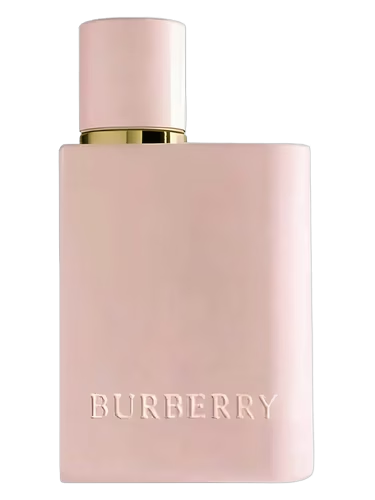
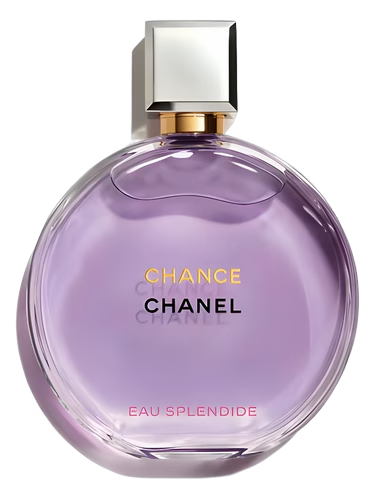
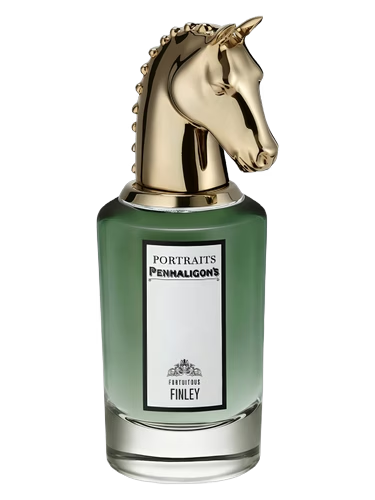
What is the Buttercup note?
The Buttercup note is a modern fragrance accord inspired by the Ranunculus species, designed to evoke the essence of wildflowers and springtime meadows.What does Buttercup smell like?
It features a bright, dewy floral profile characterized by fresh, slightly green crispness and a subtle honeyed sweetness.Is Buttercup a natural or synthetic note?
In perfumery, Buttercup is primarily a synthetic accord reconstructed using headspace technology, as the natural flower does not produce a stable or significant yield of essential oil.What are some top perfumes featuring Buttercup?
Popular fragrances featuring this note include Kensie Buttercup Babe, Earthling Perfume Buttercup, and Bath & Body Works Buttercups & Berry Bellini.When is Buttercup in season?
Buttercups typically bloom in late winter and early spring, with most temperate species reaching their peak showy period for three to four weeks during the spring.