Fragrance Notes Are Layers Of Scent That Are Layered To Form The Final Fragrance. Fragrance Notes Are Categorised Into Three Main Elements Based On How Long They Take To Evaporate, And How Long They Typically Last Following Application: Top Notes, Heart Notes And Base Notes.
Bread Flower
Bread Flower offers a rich, intoxicating floral heart blending jasmine and rice pandan. It features a unique, complex aroma with sweet, delicate touches and complex undertones. The profile is often enhanced by coastal notes, evoking a gentle, marine breeze, sometimes settling into a damp, bready dry-down.

Origin & Extraction Of Bread Flower
The "Bread Flower" note in perfumery is inspired by the natural scent of the Vallaris Solanacea flower, which is native to Thailand. Unlike classic floral notes that have centuries of history in European perfumery, the incorporation of Bread Flower is a contemporary development. Its unique olfactory profile, a complex blend of rich jasmine, starchy rice pandan, and sometimes marine or coastal nuances, positions it outside the traditional framework of Western fragrance structures. Its use signals a trend toward exploring exotic, photorealistic, and unconventional floral accords, often championed by niche and artisanal perfume houses.
As a defined perfume note, Bread Flower does not carry the long historical legacy of foundational ingredients like rose or bergamot. Instead, its relevance is tied to modern perfumery's pursuit of novel, evocative narratives. By combining delicate floral components with distinct gourmand (bready/pandan) and sometimes aquatic characteristics, this note offers perfumers a tool to create fragrances that evoke specific sensory experiences, such as the tranquility of tropical landscapes or a gentle marine breeze, providing a distinct and memorable identity to contemporary compositions.
As a distinctive and relatively modern note in perfumery, Bread Flower (Vallaris Solanacea) is often utilized by contemporary, niche, and artisanal houses seeking unique floral-gourmand narratives. Its blend of rich jasmine and starchy, bready/rice pandan undertones makes it a complex choice for perfumers moving beyond classic florals. This complexity allows the note to anchor exotic and highly conceptual fragrances.
One of the houses most closely associated with featuring the Bread Flower note is Strangers Parfumerie, known for exploring unconventional and culturally rich scent profiles. Their fragrance, Chokedee (โชคดี), prominently showcases the note, offering a unique olfactory snapshot. Additionally, their 2017 release, La Malila, also utilizes Bread Flower, highlighting its sweet, intoxicating floral heart within a sophisticated, wearable composition.
Beyond Strangers Parfumerie, Bread Flower's subtle yet evocative profile has found a place in other modern compositions. Fragrances like Tobacco Rose by Butterfly Thai Perfume, Evenbloom by NOMR, and Nostaljardin by Odyssey demonstrate how this unique note provides a distinctive, slightly gourmand floral warmth, offering complexity and depth that differentiates these scents from more traditional citrus or rose-centric fresh fragrances.
Sustainability Of Bread Flower
Sustainability of Bread Flower
- Promoting resource and energy efficiency by adopting renewable energy sources and installing energy-monitoring systems to reduce carbon footprints during production
- Advancing a circular economy through the use of 100% recyclable and compostable packaging, such as wax paper, to minimize landfill waste
- Implementing water-saving measures including rainwater harvesting for facility operations and the installation of advanced water meters to monitor and reduce consumption
- Supporting regenerative and organic agriculture by sourcing flours grown without synthetic pesticides or herbicides, which enhances soil health and protects biodiversity
- Committing to ethical sourcing through memberships in organizations like the Roundtable on Sustainable Palm Oil (RSPO) to ensure responsible supply chain management
- Enhancing operational efficiency with energy-saving technologies such as 100% LED lighting with motion and daylight sensors in bakeries and dispatch areas
Trivia
The bread flower (Vallaris solanacea) is native to Thailand and is uniquely prized for an aroma that captures the scent of hot, jasmine-infused basmati rice or freshly baked bread.
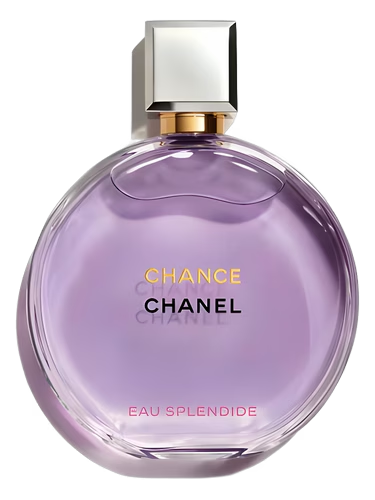
Most Popular Scents Using Bread Flower


What is Bread Flower?
Bread Flower is an exotic perfume note inspired by the Vallaris solanacea flower native to Thailand, known for its unique scent resembling jasmine and freshly baked bread.What does Bread Flower smell like?
It offers a rich, intoxicating aroma that blends sweet jasmine with starchy rice pandan and subtle marine or coastal nuances, often settling into a damp, bready dry-down.How is Bread Flower essence extracted?
In modern perfumery, the Bread Flower note is typically a synthetic creation designed to replicate the unique olfactory profile of the Vallaris solanacea plant.What are some top perfumes featuring Bread Flower?
Notable fragrances include Strangers Parfumerie Chokedee, Profumo di Firenze Fior di Pane, Serge Lutens Jeux de Peau, and Pearfat Parfum Bread + Roses.When is Bread Flower in season?
The note is associated with the arrival of spring in March, symbolizing new beginnings, though the actual flower typically blooms repeatedly during warm months.