Fragrance Notes Are Layers Of Scent That Are Layered To Form The Final Fragrance. Fragrance Notes Are Categorised Into Three Main Elements Based On How Long They Take To Evaporate, And How Long They Typically Last Following Application: Top Notes, Heart Notes And Base Notes.
Boysenberry
Boysenberry in perfumery presents a rich, sweet, and slightly tart berry aroma, capturing the essence of blackberry and raspberry with a more complex, jammy depth. It's often utilized to introduce a juicy, succulent sweetness, balanced by subtle green or woody undertones for a natural, sophisticated fruit accord. The note adds lushness and brightness, especially in fruity-floral and gourmand compositions, evoking warmth and richness.

Origin & Extraction Of Boysenberry
The boysenberry is a relatively modern fruit hybrid, developed in the 1920s and named after its originator, Rudolph Boysen. Due to its recent introduction compared to classic fruits, the boysenberry note is not found in traditional perfumery structures like Eau de Cologne or historical French compositions. Its relevance in fragrance is distinctly modern, emerging as perfumers sought complex, luscious, and hyper-realistic fruit accords in the late 20th and early 21st centuries. The note is especially favored in contemporary fruity-floral and gourmand genres.
In modern perfumery, the boysenberry note is used to introduce a rich, jammy depth that goes beyond the simpler sweetness of standard red berries. It is valued for its complex profile—a blend of blackberry and raspberry with subtle tartness—which offers greater longevity and sophistication. This makes it an ideal choice for niche and designer houses looking to create vibrant, full-bodied fruity openings that anchor the composition and seamlessly transition into the heart notes.
Extraction Methods of Boysenberry
The primary method for obtaining boysenberry essence and juice involves mechanical extraction from the skin, pulp, and seeds. This process typically includes pressing the fruit to create a natural sugar solution, which is then depectinized, filtered, and evaporated under vacuum to create a stable concentrate. For flavoring extracts used in commercial food production, natural flavors are often concentrated using ethyl alcohol and glycerin to capture the fruit's sweet-tart profile.
Historically, boysenberry extraction relied on classical analytical methods such as maceration with solvents like acetone, followed by filtration and evaporation. Traditional preservation often involved manual processing into jams, syrups, and purees. More recent advancements have introduced sophisticated techniques to preserve heat-sensitive antioxidants like anthocyanins. Modern methods include freeze-drying (lyophilization) at low temperatures to maintain nutritional integrity, supercritical CO2 extraction, and 100% Aqua Pure water-based extraction processes. Additionally, high-performance liquid chromatography (HPLC) and mass spectrometry (LC-MS) are now standard for isolating and verifying the purity of specific bioactive compounds within the berry.
The Boysenberry note, known for its rich and jammy blend of blackberry and raspberry, lends a distinctive, succulent sweetness to modern fragrances. While it may not be a traditional cornerstone like citruses or florals, it features prominently in contemporary compositions that aim for a lush, gourmand, or fruity-floral character. Its complexity allows it to bridge the gap between sparkling top notes and deeper, warmer bases.
- One notable example of the Boysenberry note is in **Gucci Guilty Absolute Pour Femme**, where it is used to create a dark, sensual, and modern fruity opening that moves away from typical sweet floral scents. The use of this berry note adds a deep, almost wine-like richness that supports the central Bulgarian rose and Goldenwood accords.
- Another fragrance where boysenberry plays a key role is **Jo Malone London's Blackberry & Bay** (though it is closely related to the prominent blackberry note), providing the intense, freshly-picked, and slightly tart sweetness that defines the scent's signature. This fragrance uses the berry to evoke a natural, earthy yet bright British countryside feel.
Furthermore, niche and independent houses frequently employ Boysenberry to craft unique, opulent scents. These houses appreciate the note's ability to offer a sophisticated, slightly tart contrast to vanilla, musk, or patchouli, preventing the composition from becoming overly saccharine. This note often appears in limited-edition or experimental gourmand fragrances, providing warmth and a comforting, rich fruit sensation that is both youthful and mature.
Sustainability Of Boysenberry
Sustainability of Boysenberry
- Adoption of organic and sustainable farming practices that prioritize long-term environmental health for future generations
- Elimination of chemical herbicides and pesticides in favor of mechanical weeding and integrated pest management using beneficial insects like ladybugs and praying mantises
- Implementation of water conservation strategies including extensive drip irrigation systems and gravity-fed pond systems to minimize waste and evaporation
- Soil health restoration through the use of organic amendments such as compost, aged manure, and nitrogen-fixing cover crops like alfalfa and clover
- Promotion of biodiversity via companion planting with repellent herbs and flowers that naturally deter pests and attract essential pollinators
- Commitment to non-GMO crops by cultivating heritage vines through traditional cross-pollination techniques
- Enhancing supply chain transparency through traceability systems that track harvest details from the specific field row to the final consumer
- Reducing waste by repurposing old canes as mulch through "chop and drop" techniques and utilizing recycled containers for harvesting
Trivia
The boysenberry is a complex hybrid of four different berries—the European raspberry, European blackberry, American dewberry, and loganberry—and every boysenberry plant in the world today can trace its roots back to a few frail, neglected vines rescued from Rudolph Boysen’s abandoned farm.
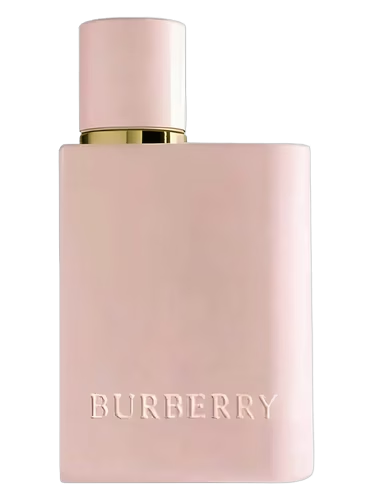
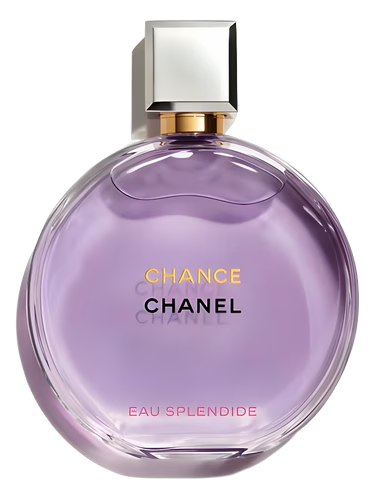
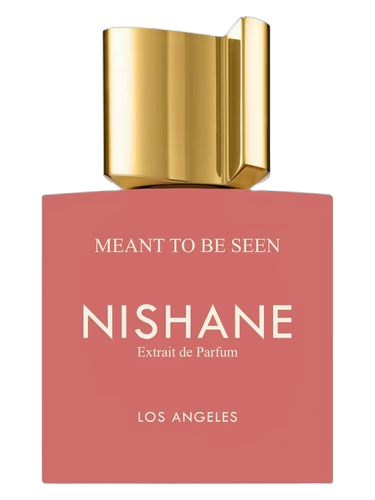
Most Popular Scents Using Boysenberry
What is Boysenberry?
The boysenberry is a modern fruit hybrid developed in the 1920s by Rudolph Boysen, combining European raspberry, European blackberry, American dewberry, and loganberry.What does Boysenberry smell like?
It offers a rich, sweet, and slightly tart aroma with a jammy depth, blending the characteristics of blackberry and raspberry with succulent sweetness.How is the Boysenberry note created in perfumery?
In fragrance, the boysenberry note is typically synthetic, though natural essence can be mechanically extracted from the fruit's skin, pulp, and seeds.What are some top perfumes featuring Boysenberry?
Notable fragrances include Yves Saint Laurent Black Opium Intense, Hugo Boss Hugo Woman Eau de Parfum, and Gucci Guilty Absolute Pour Femme.When is Boysenberry in season?
The primary harvest season for boysenberries spans from late spring through early summer, typically peaking between June and August.