Fragrance Notes Are Layers Of Scent That Are Layered To Form The Final Fragrance. Fragrance Notes Are Categorised Into Three Main Elements Based On How Long They Take To Evaporate, And How Long They Typically Last Following Application: Top Notes, Heart Notes And Base Notes.
Bougainvillea
Bougainvillea offers a bright, complex floral profile blending tropical and green facets. It opens with lotus flower and Brazilian mandarin/bergamot zest, moving into a rich heart of magenta rose, osmanthus, and peach blossom. The drydown features a subtle warmth from red sandalwood, amber, and night phlox.

Origin & Extraction Of Bougainvillea
The Bougainvillea flower, native to South America, is widely recognized for its vibrant bracts rather than its scent, as the true flower possesses only a subtle fragrance. Because of its delicate natural aroma, the Bougainvillea note in perfumery is primarily a concept or fantasy note, reconstructed through creative blending of other, more potent floral and citrus materials. This approach places its history of use firmly in modern perfumery, particularly as houses sought to capture the olfactory experience of a lush, tropical garden, often featuring it in bright, colorful compositions rather than traditional floral structures.
Its adoption coincides with the late 20th and early 21st-century trend of creating photorealistic and exotic floral bouquets. Perfumers use accords that combine zesty citrus (like mandarin or bergamot) and rich, magenta-hued florals (such as rose or osmanthus) to evoke the visual vibrancy and abstract tropical quality of the plant. As a result, the Bougainvillea note does not have a long, foundational legacy like rose or jasmine but is instead appreciated as a contemporary, evocative element used to add brightness, complexity, and a sense of sun-drenched exoticism to a fragrance.
Extraction Methods of Bougainvillea
Historically, the extraction of bioactive compounds and pigments from bougainvillea flowers was achieved through simple maceration and soaking techniques. Traditional methods involved drying the floral bracts at room temperature or using low-heat ovens, followed by grinding them into a fine powder. This powder was then submerged in solvents such as water or ethanol for extended periods, sometimes up to 72 hours, to naturally draw out the desired essences and colors. Manual stirring or shaking was often the only mechanical aid used to facilitate the transfer of compounds into the liquid medium.
In modern commercial and scientific applications, traditional maceration has been largely replaced or enhanced by more efficient "green" technologies. Microwave-Assisted Extraction (MAE) and Ultrasound-Assisted Extraction (UAE)—using both bath and probe sonication—are now widely employed to significantly reduce extraction time and solvent consumption while increasing the yield of sensitive antioxidants like betacyanins. Recent developments also include the use of supercritical CO2 extraction and nanoencapsulation techniques, where extracts are trapped within biopolymers like maltodextrin or seed gums to protect the delicate aromatic and medicinal molecules from degradation.
The Bougainvillea note, often a fantasy accord due to the natural flower's subtle scent, is utilized to inject a vibrant, tropical brightness into fragrances. While not as common as notes like jasmine or rose, it appears in modern compositions seeking to capture the color and exoticism of a lush garden. These scents typically blend zesty citrus and rich floral facets, reflecting the plant's visual appeal and abstract tropical character.
- Bougainvillea by YANI (2024) is a recent example where this note is prominently featured. Created by Nathalie Templer, the fragrance is built around a fruity and floral core, featuring top notes like Grapes, Williams Pear, Mandarin Orange, and Pineapple, complemented by a floral heart before drying down to a base of Patchouli, Amber, and Musk. The inclusion of the Bougainvillea note positions this fragrance as a bright, elegant, and modern tropical scent.
Because the Bougainvillea note is a creative construction, it is often found in niche or designer fragrances focused on evocative imagery. Perfumers use this accord to add a unique, sun-drenched floral layer, frequently pairing it with other white florals or fruits. This technique allows the note to communicate a sense of humid air, colorful petals, and the general ambience of a South American garden, referencing the flower's native origin.
Sustainability Of Bougainvillea
Sustainability of Bougainvillea
- Promoting sustainable landscaping by utilizing its high drought tolerance and minimal water requirements once established
- Supporting local biodiversity and ecosystems as a pollinator haven for bees, butterflies, and hummingbirds
- Enhancing soil conservation and stabilization in arid or sloped landscapes through its extensive root system
- Advancing a circular economy by producing botanical confetti from petals as an eco-friendly alternative to synthetic products
- Contributing to sustainable urban greening by reducing the urban heat island effect and providing natural, thorny barriers that reduce the need for artificial materials
- Supporting food security and green chemistry through research into flowers as natural antioxidant additives and colorants to replace nitrites in food processing
Trivia
Despite being a popular fantasy note in perfumery, the bougainvillea plant is actually odorless, meaning any "bougainvillea" scent is a creative interpretation of the hot sun and dust associated with the Mediterranean and South America.
Most Popular Scents Using Bougainvillea
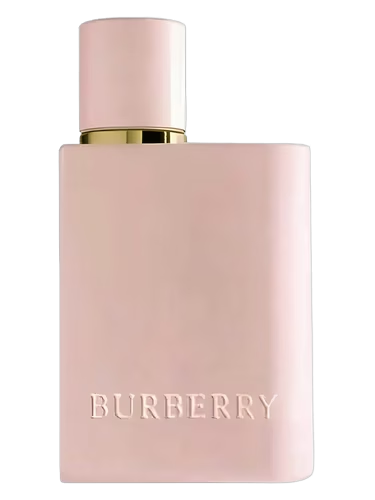
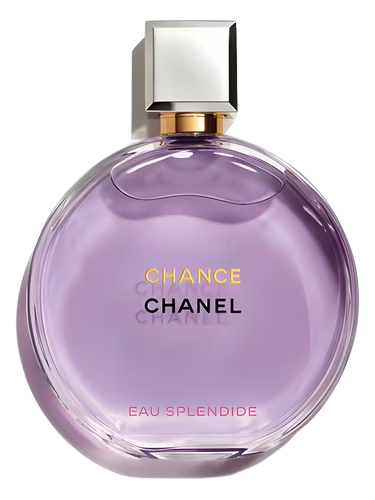
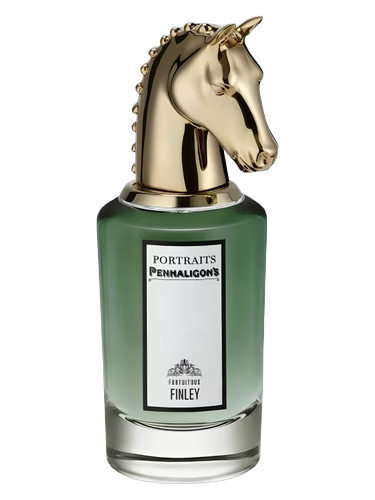
What is the Bougainvillea note?
In perfumery, Bougainvillea is a fantasy note used to evoke the tropical, sun-drenched atmosphere of a lush garden, as the natural plant possesses very little scent.What does Bougainvillea smell like?
The accord typically features a bright, complex profile with tropical and green facets, often blending zesty citrus, rose, and osmanthus to mimic its vibrant visual appearance.How is the Bougainvillea scent captured?
Because the flower is essentially odorless, perfumers reconstruct the note using creative accords of sheer florals, warm musks, and dry woody notes to simulate a Mediterranean or South American ambiance.What are some top perfumes featuring Bougainvillea?
Notable fragrances that utilize this fantasy note include Estée Lauder Bronze Goddess Aegea, Escada Santorini Sunrise, and YANI Bougainvillea.Is there a natural Bougainvillea extract?
While bioactive compounds can be obtained through maceration or modern green technologies like microwave-assisted extraction, these are primarily used for their antioxidant and pigment properties rather than for fragrance.