Fragrance Notes Are Layers Of Scent That Are Layered To Form The Final Fragrance. Fragrance Notes Are Categorised Into Three Main Elements Based On How Long They Take To Evaporate, And How Long They Typically Last Following Application: Top Notes, Heart Notes And Base Notes.
Bottlebrush
Bottlebrush offers a bright, subtly spicy, and intensely green floral profile, reminiscent of a blend of honeyed sweetness and crisp foliage. It presents a unique, airy freshness with balsamic undertones, often used in niche perfumery to add an exotic, natural, and slightly metallic nuance to floral bouquets or green compositions.

Origin & Extraction Of Bottlebrush
The Bottlebrush note, derived from the Australian native shrub (Callistemon), does not possess a deep history in classic perfumery, which was traditionally dominated by European and Middle Eastern ingredients. Its fragrant flowers, known for their unusual shape and subtle aroma, were not widely explored until modern perfumers began seeking unique, exotic, and naturalistic green floral profiles to distinguish their niche and contemporary compositions.
In modern perfumery, Bottlebrush has emerged as a specialized ingredient, valued for its ability to bridge bright green and subtly spicy facets with a light, honeyed floral sweetness. It is primarily utilized to add an airy, complex, and slightly metallic or balsamic freshness, often lending an authentic "botanical garden" feel to fragrances, making it a sophisticated choice for innovative floral and green accords.
Extraction Methods of Bottlebrush
The primary method for extracting the essential oil of bottlebrush (Callistemon) is hydro-distillation, traditionally performed using a Clevenger-type apparatus. In this process, the plant material—most commonly the leaves—is submerged in water and boiled, allowing the steam to carry volatile aromatic compounds through a condenser where they are cooled back into a liquid state and separated from the water.
Historically, extraction relied on simple manual methods such as soaking blossoms in hot liquids to release nectar or steeping leaves in hot water to create infusions and medicinal teas. For more concentrated essences, traditional solvent extraction and simple maceration techniques were employed to capture the plant's phytochemicals.
Modern developments have introduced advanced techniques to enhance yield and efficiency. These include ultrasound-assisted steam distillation, which utilizes ultrasonic waves to disrupt plant cell walls, and supercritical CO2 extraction, which captures delicate aromatic molecules without the use of high heat or synthetic solvents. Additionally, innovative cellular extraction methods are now used to isolate water-soluble phyto-compounds while maintaining their natural integrity.
The Bottlebrush note, with its distinctive blend of subtly spicy, intensely green, and airy honeyed floral facets, is primarily embraced by niche and artisanal perfumery rather than mainstream designer houses. Due to its exotic Australian origin, it provides a unique, photorealistic "botanical garden" dimension to modern compositions. This note is valued for its capacity to bridge traditional fresh green accords with an unusual, slightly metallic floral sweetness, offering sophistication and a sense of natural authenticity.
- The most notable usage of Bottlebrush is often found in creations that aim for a bright, nature-inspired freshness. For example, some specialized collections seeking to capture the Australian landscape may prominently feature this note to evoke the scent of the native Callistemon shrub.
While specific, globally recognized mainstream "famous perfumes" are scarce for such a specialized ingredient, Bottlebrush has been highlighted in compositions like those from the Australian brand Goldfield & Banks, where indigenous notes are central to the house's identity. These scents utilize the note for its vivid green character and slight balsamic undertones, often appearing alongside other vibrant florals and woods to construct a complex, exotic bouquet, appealing to the contemporary demand for unique and complex green florals.
Sustainability Of Bottlebrush
Sustainability of Bottlebrush
- Promoting biodiversity by providing nectar-rich flowers that attract and support essential pollinators like bees, butterflies, and hummingbirds
- Implementing natural soil stabilization and erosion control through the plant's robust root system, which helps improve soil quality in degraded areas
- Adopting water-efficient landscaping practices by utilizing the plant's natural drought tolerance, making it ideal for water-scarce regions once established
- Supporting urban greening and air quality improvement by absorbing carbon dioxide and releasing oxygen in city environments
- Reducing chemical reliance through the cultivation of a low-maintenance species that is naturally resistant to many pests and diseases
- Advancing conservation efforts through community-led planting initiatives and the development of national recovery plans for vulnerable wild species
Trivia
Despite its common name, the bottlebrush plant is actually a member of the myrtle family and produces unique "woolly" filaments that mimic the look of a traditional bottle cleaner to specifically attract nectar-feeding birds.
Most Popular Scents Using Bottlebrush
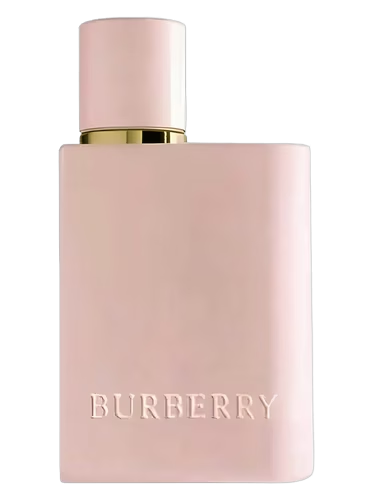
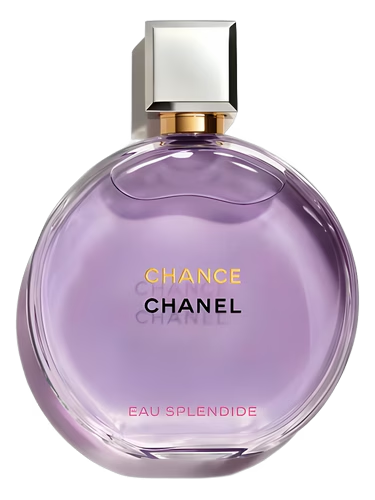
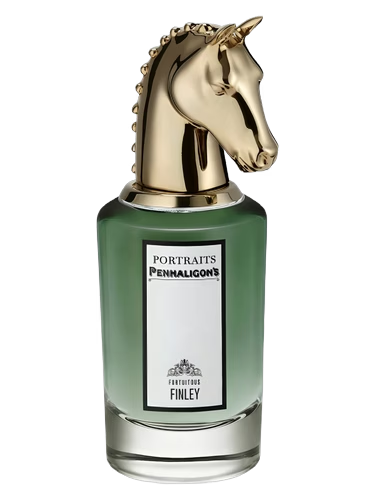
What is Bottlebrush?
Bottlebrush is a note derived from the Australian native Callistemon shrub, known for its unique flower spikes and modern use in niche perfumery.What does Bottlebrush smell like?
It offers a bright, intensely green floral profile with subtle spicy facets, airy honeyed sweetness, and a crisp, slightly metallic or balsamic freshness.How is Bottlebrush essence extracted?
The essential oil is primarily extracted through hydro-distillation of the plant's leaves, though modern methods like supercritical CO2 extraction are also used.What are some top perfumes featuring Bottlebrush?
While rare in mainstream scents, it is a signature note for the Australian brand Goldfield & Banks, which uses it to capture authentic botanical landscapes.When is Bottlebrush in season?
The plant typically blooms in spring and early summer, though in tropical climates, some varieties can flower continually throughout the year.