Fragrance Notes Are Layers Of Scent That Are Layered To Form The Final Fragrance. Fragrance Notes Are Categorised Into Three Main Elements Based On How Long They Take To Evaporate, And How Long They Typically Last Following Application: Top Notes, Heart Notes And Base Notes.
Blue Poppy
Blue Poppy (Meconopsis) offers an ethereal, dewy floral note, combining delicate, slightly powdery blue-green facets with a hint of crisp, ozonic freshness. It suggests a cool, transparent scent, often interpreted with watery nuances, gentle spice, and subtle mineral or metallic undertones to convey its vibrant color and fragile nature.

Origin & Extraction Of Blue Poppy
The Blue Poppy, derived from the Meconopsis genus, holds a place in perfumery as a highly conceptual and modern note, as the true flower itself offers a scent that is subtle and difficult to extract naturally for commercial use. Historically, it does not possess the legacy of classic florals. Its prominence arose in the late 20th and 21st centuries when perfumers began creating "fantasy" notes—using combinations of existing materials to evoke a specific visual, texture, or mood. The appeal of the Blue Poppy lies in its vibrant color and exotic, Himalayan origin, inspiring perfumers to construct an ethereal, cool, and transparent scent profile.
In fine fragrance, the Blue Poppy note is primarily used to lend a dewy, aquatic, and slightly powdery blue-green freshness to compositions, often associated with mineral or ozonic accords. Its relevance is tied to niche and contemporary perfumery that seeks to capture abstract concepts and delicate natural beauty. This constructed note functions not as a literal floral replication, but as an accent of cool sophistication, bridging the gap between watery freshness and subtle, delicate spice to add complexity to floral or oriental compositions.
Extraction Methods of Blue Poppy
Historically, the extraction of alkaloids from the blue poppy (Papaver somniferum) was primarily achieved through the manual incising of unripe seed pods, a process known as lancing. This traditional method involves making shallow vertical slits in the pod with a curved knife to allow a milky, white latex to exude. As this sap contact air, it thickens and darkens into a brownish-black gum called opium, which is then scraped off and collected. This raw opium serves as the base for further chemical refinement into morphine and other derivatives through a process of boiling with lime and ammonia, followed by filtration and concentration.
Modern commercial and industrial methods have shifted toward the "poppy straw" or Concentrate of Poppy Straw (CPS) technology, developed in the 1920s by Janos von Kabay. Instead of manual lancing, the entire plant is mown down after the flowers bloom or when the plant is ripe and dry. The pods and stalks are crushed and pulverized, then subjected to large-scale chemical extraction using water, acids, or solvents like methanol and acetonitrile. This process allows for the simultaneous harvest of seeds for the food industry while extracting high concentrations of morphine and codeine directly from the plant material, offering a more efficient and easier-to-regulate alternative to opium production. Contemporary analytical techniques, such as liquid chromatography coupled with mass spectrometry (LC-MS/MS), are now standard for extracting and monitoring alkaloid levels on poppy seeds to ensure they meet modern safety regulations.
The ethereal and conceptual Blue Poppy note is perhaps most famously known for its inclusion in Lancôme's classic fragrance, Poême (1995). Although Poême is primarily an opulent white floral and oriental scent, the subtle, dewy, blue-green facet often attributed to the Blue Poppy note contributes to the fragrance's complex luminosity, preventing the composition from becoming overly heavy or dated. It serves as an imaginative touch that supports the main notes of mimosa and tuberose, lending a quiet, abstract freshness.
In contemporary perfumery, the Blue Poppy note is utilized by niche houses seeking sophisticated freshness. For instance, Ormonde Jayne’s Kashmir (2024) employs this note to evoke a cool, transparent, and slightly spicy elegance, complementing its blend of woody and oriental accords. This use highlights the note's ability to bridge aquatic or ozonic freshness with deeper, more textured bases, leveraging its exotic, Himalayan inspiration to create a sense of refined mystery.
The note also appears in mainstream scents to add an invigorating, subtle complexity, such as in Lucky Brand's Lucky You for Women (2000). In such compositions, the Blue Poppy contributes its delicate, slightly powdery, blue-green nuance to enhance the fresh and uplifting character of the fragrance. Its role is often to add a unique, clean, and airy dimension to familiar fruity-floral structures, providing a distinctive signature without dominating the overall scent profile.
Sustainability Of Blue Poppy
Sustainability of Blue Poppy
- Preserving biodiversity through international conservation efforts and botanical exhibitions to save the rare Himalayan blue poppy from extinction
- Protecting endangered species from medicinal hunters by promoting sustainable seed distribution and cultivation in specialized botanical gardens
- Supporting the use of natural and sustainable fibers, such as organic cotton and bamboo viscose, to reduce the environmental impact of textile production
- Implementing circular economy principles by repurposing vintage textiles, brocade saris, and indigo block prints into handcrafted fashion and jewelry
- Reducing plastic waste by transitioning to 100% compostable shipping and packing materials and reusing existing supplies like bubble wrap
- Promoting ethical social impact by partnering with OEKO-Tex certified manufacturers and supporting women and minority-owned small businesses
Trivia
The Himalayan blue poppy is so rare and its fluorescent color so unusual that for many years it was considered a myth, with early explorers questioning if the vibrant "Cambridge blue" flower actually existed in the wild.
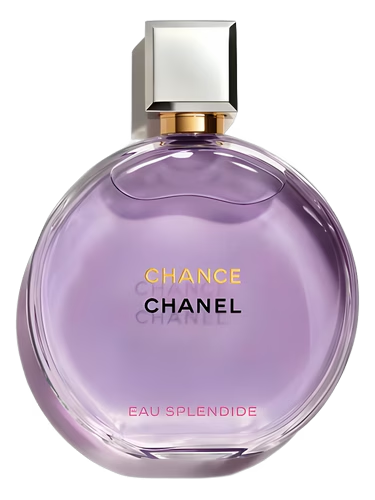
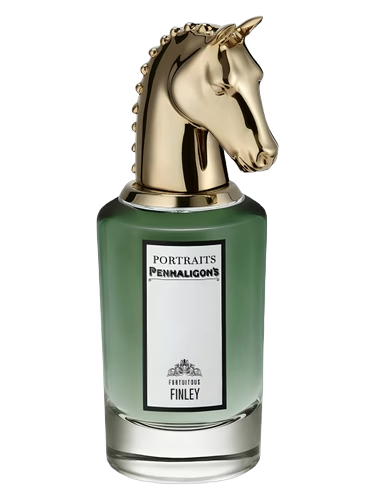
Most Popular Scents Using Blue Poppy

What is Blue Poppy?
Blue Poppy, derived from the Meconopsis genus, is a conceptual and modern fragrance note inspired by the rare, vibrant flowers native to the eastern Himalayas.What does Blue Poppy smell like?
It offers an ethereal, dewy floral aroma with slightly powdery blue-green facets, crisp ozonic freshness, and subtle mineral or metallic undertones.How is the Blue Poppy note created in perfumery?
Because the natural scent is difficult to extract, perfumers create it as a synthetic "fantasy" note by blending existing materials to evoke its cool, transparent profile.What are some top perfumes featuring Blue Poppy?
Notable fragrances include Lancôme Poême, Ormonde Jayne Kashmir, NEST New York Wisteria Blue, and Lucky Brand Lucky You for Women.When is Blue Poppy in season?
The real flower typically follows a growth cycle beginning in early spring, with flowering generally occurring from late spring through July.