Fragrance Notes Are Layers Of Scent That Are Layered To Form The Final Fragrance. Fragrance Notes Are Categorised Into Three Main Elements Based On How Long They Take To Evaporate, And How Long They Typically Last Following Application: Top Notes, Heart Notes And Base Notes.
Blue Lilies
Blue Lilies offer a fresh, ethereal, and subtly aquatic floral profile. The scent is delicate and dewy, often conveying a translucent quality with hints of greenness, reminiscent of water-soaked petals. It is crisp, clean, and possesses a slightly sweet, airy elegance, providing a cool, shimmering lift to compositions.

Origin & Extraction Of Blue Lilies
The history of "Blue Lilies" in perfumery is closely related to the cultural and aromatic history of the Blue Lotus or Blue Waterlily (Nymphaea caerulea). This flower was revered in ancient Egypt and India, symbolizing creation, rebirth, and transcendence. Although its use in historical fragrant oils and rituals dates back thousands of years—as evidenced by ancient Egyptian artifacts—its presence in traditional Western fine perfumery was less common until the modern era.
In contemporary perfumery, the Blue Lilies note is typically synthesized to capture a clean, ethereal, and subtly aquatic floral profile. It gained prominence alongside the rise of sheer and aquatic fragrances in the late 20th and early 21st centuries. Perfumers utilize this note to provide a cool, translucent freshness and an airy elegance, offering a delicate, dewy quality that distinguishes it from heavier white florals, making it ideal for light, shimmering compositions.
Extraction Methods of Blue Lilies
Historically, the aromatic and bioactive compounds of blue lilies, such as Nymphaea caerulea (Blue Lotus), were captured through simple traditional methods like maceration in wine or water and basic steam or water distillation. These early techniques focused on creating medicinal tinctures, floral waters, and teas to harness the plant's relaxing and psychoactive properties. Soxhlet extraction also served as a long-standing laboratory method for producing concentrated extracts using volatile solvents like ethanol, methanol, or chloroform.
Modern extraction has evolved to utilize more precise and efficient technologies that preserve delicate phytochemicals while minimizing solvent waste. Advanced methods now include ultrasonic-assisted extraction (UAE) and enzymatic-assisted extraction (EAE), which break down plant cell walls to enhance the release of flavonoids and phenolics. For fragrance and volatile compound analysis, headspace solid-phase microextraction (HS-SPME) combined with gas chromatography-mass spectrometry (GC-MS) allows for the solvent-free capture of scents from live flowers. Additionally, high-precision techniques such as pressurized liquid extraction and double-extraction tinctures are increasingly employed to maximize the bioavailability of active alkaloids like apomorphine and nuciferine.
The ethereal, subtly aquatic floral profile of Blue Lilies—often capturing the essence of the Blue Waterlily or Blue Lotus—is highly valued in contemporary perfumery for introducing a clean, translucent freshness. While the note is not part of the historical foundations of the classical fragrance houses, it has become essential in modern compositions aiming for sheer elegance and a cool, dewy lift. Fragrances such as **Blue Lilies** by Mary Kay demonstrate the use of this note to achieve a simple, bright, and airy feminine scent.
The versatility of the Blue Lilies note allows it to be used across different fragrance categories, from light florals to deeper, more complex oriental blends. In recent releases, it often acts as a shimmering top or heart note to balance richer ingredients. For example, in **Blue Oud** by Ibraheem AlQurashi, the delicate floral aquatic quality of the blue lilies note likely provides a contrast to the density of the oud, creating an intriguing blend of fresh transparency and dark warmth.
The aquatic and slightly sweet nature of Blue Lilies also makes it a popular choice for light-hearted, modern releases, suitable for both masculine and feminine wear, often appearing in flankers or themed collections. Newer fragrances like **Zodiac Aqua** by Faberlic and **Deep Blue** by Reserved incorporate this note to emphasize their connection to water, vitality, and cooling refreshment, highlighting its modern utility in providing an invigorating and sophisticated watery floral touch.
Sustainability Of Blue Lilies
Sustainability of Blue Lilies
- Promoting climate-resilient livelihoods through the development of eco-tourism and sustainable agriculture initiatives
- Implementing regenerative farming practices that improve soil health and integrate beekeeping for natural pollination
- Reducing the environmental footprint of cultivation by minimizing the use of synthetic pesticides and herbicides
- Advancing social sustainability by empowering women and local communities through micro-finance and equal access to farmlands
- Supporting biodiversity conservation through the protection and restoration of local ecosystems and habitats
Trivia
Blue water lily petals were found draped over the sarcophagus of King Tutankhamun when his burial chamber was opened in 1922, reflecting its ancient status as a sacred symbol of the sun and rebirth.
Most Popular Scents Using Blue Lilies


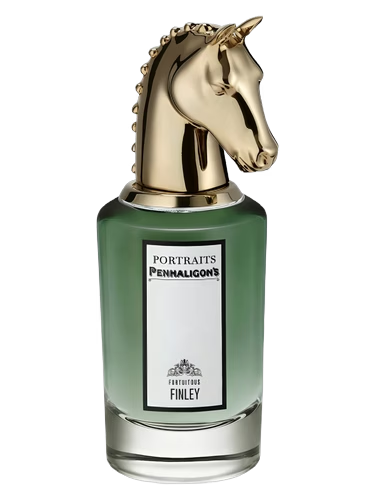
What is the Blue Lilies fragrance note?
In perfumery, Blue Lilies (often associated with the Blue Lotus or Blue Waterlily) is a fresh, ethereal, and subtly aquatic floral note known for its dewy, translucent quality.What do Blue Lilies smell like?
The scent is crisp, clean, and airy with a slight sweetness and green nuances, providing a cool, shimmering lift reminiscent of water-soaked petals.How is the essence of Blue Lilies extracted?
Modern perfumery typically utilizes solvent extraction or advanced techniques like ultrasonic-assisted extraction to capture its delicate aromatic compounds.What are some top perfumes featuring Blue Lilies?
Popular fragrances include Mary Kay Blue Lilies, Orlov Paris Blue Lili, Jo Malone London Waterlily Cologne, and Ibraheem AlQurashi Blue Oud.What is the historical significance of Blue Lilies?
Revered in ancient Egypt and India, the flower symbolized creation, rebirth, and transcendence, with petals famously found in King Tutankhamun's sarcophagus.When are Blue Lilies in season?
The plant primarily flourishes during the summer months, with peak blooms typically appearing between June and August in warm climates.