Fragrance Notes Are Layers Of Scent That Are Layered To Form The Final Fragrance. Fragrance Notes Are Categorised Into Three Main Elements Based On How Long They Take To Evaporate, And How Long They Typically Last Following Application: Top Notes, Heart Notes And Base Notes.
Bitter melon
Bitter melon in perfumery offers a unique, green, and slightly acerbic scent, often presenting a fresh, aquatic bitterness with vegetal nuances. It can be used to add an unexpected, sharp edge to compositions, balancing sweeter notes or enhancing a crisp, contemporary green accord.

Origin & Extraction Of Bitter melon
Bitter Melon, or *Momordica charantia*, is not a traditional historical note in classical Western perfumery, which historically favored essential oils from readily available European and Middle Eastern botanicals like citrus, rose, and spices. The introduction of highly unusual or overtly vegetal notes like bitter melon is a development of modern, often niche and experimental, perfumery. The focus in modern compositions shifted toward realism and unexpected contrasts, driving perfumers to source unique, challenging profiles to achieve specific green or aquatic effects, often mimicking the raw, damp smell of a garden.
Its use is primarily driven by contemporary perfumers seeking to move beyond conventional sweetness and to introduce a stark, acerbic freshness. Bitter melon functions as an avant-garde ingredient, prized for its ability to lend a crisp, sharp edge that cuts through other accords. Its relevance in perfumery, therefore, is rooted in the late 20th and 21st centuries, where it helps define high-impact, minimalist, or hyper-naturalistic fragrances that aim to evoke raw nature or complex vegetal bitterness rather than generalized floral or citrus themes.
Extraction Methods of Bitter Melon
Historically, bitter melon (Momordica charantia) compounds were obtained through traditional solvent extraction methods like maceration, where plant parts were soaked in water or alcohols to capture bioactive elements. Ancient medicinal practices often involved simmering the fruit to create decoctions or using simple filtration to recover extracts. Traditional concentration techniques relied on manual pounding of dried fruits and seeds followed by basic solvent infusion, a process that was often time-consuming and offered variable efficiency.
Modern extraction has evolved to include more precise and efficient technologies such as microwave-assisted extraction (MAE) and ultrasound-assisted extraction (UAE), which significantly reduce processing time and solvent use while improving purity. Recent developments also include subcritical water extraction (SCWE) and supercritical carbon dioxide (SC-CO2) extraction, which allow for the selective recovery of specific compounds like flavonoids and triterpenoids without the use of harsh chemicals. Current commercial standards often utilize high-speed centrifugation and rotary evaporation under vacuum to isolate and concentrate the final essence or nutraceutical ingredients.
As an unconventional note, Bitter Melon (or Momordica charantia) is not widely featured in mainstream commercial perfumery, which tends to favor traditional fruit and floral accords. However, its sharp, green, and aquatic bitterness makes it a compelling ingredient in niche and avant-garde fragrances designed for unexpected, crisp, and vegetal freshness. Perfumes that use this note often seek to evoke a high-definition, wet, and slightly acerbic green accord, moving away from soft sweetness toward a challenging, natural complexity.
- A notable example is found in the work of certain independent perfumers who utilize the complexity of unique vegetal notes. One fragrance that might incorporate a similar sharp, green aquatic element is **A Scent by Issey Miyake**, although this is an interpretation based on the desire for a "crisp green accord" rather than a confirmed inclusion of Bitter Melon itself.
The spirit of the Bitter Melon note—its unusual blend of greenness, sharpness, and clean aquatic bitterness—is often seen in modern, minimalist scents. These fragrances prioritize clarity and natural textures. For example, while not containing Bitter Melon, the intent and result might be conceptually aligned with the challenging greenness of scents like **Diptyque's L'Ombre dans l'Eau**, which relies on intensely green, slightly sharp notes to achieve its unique profile. Bitter Melon's potential lies in its ability to anchor modern, high-contrast green compositions.
Sustainability Of Bitter melon
Sustainability of Bitter Melon
- Reducing environmental impact by using recycled materials like old newspapers to protect fruit from pests and sunburn instead of plastic bags
- Minimizing pesticide use through the implementation of physical barriers and integrated pest management strategies to protect both human health and local ecosystems
- Enhancing soil health and carbon sequestration by incorporating cover crop residues, organic mulch, and animal manure as natural fertilizers
- Promoting water conservation through the use of drip irrigation systems that deliver moisture directly to roots and reduce overall water consumption
- Fostering socioeconomic resilience by adopting low-cost cultivation techniques, such as bamboo trellising, to reduce financial overhead for smallholder farmers
- Supporting agricultural biodiversity and food security by diversifying crop portfolios with hardy, tropical varieties well-suited to changing climates
Trivia
The genus name of the bitter melon, Momordica, is derived from the Latin word for "to bite," referring to the jagged edges of its leaves which appear as though they have been nibbled by an animal.
Most Popular Scents Using Bitter melon
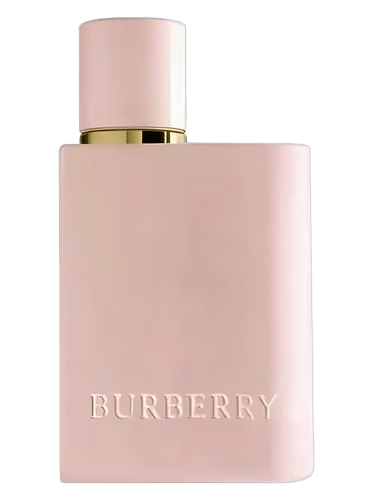
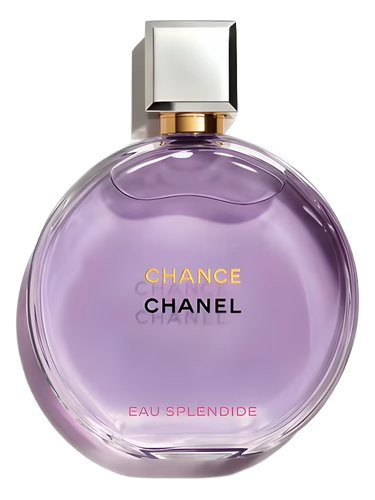
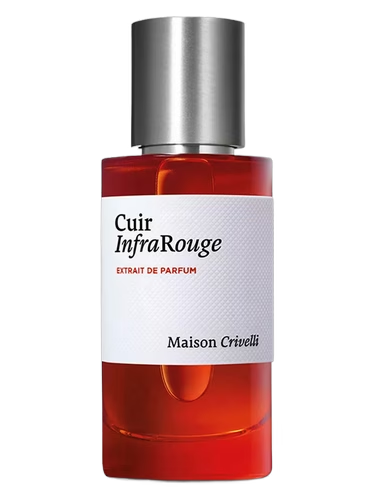
What is Bitter melon?
Bitter melon, or Momordica charantia, is a tropical fruit used in modern perfumery to provide a unique, green, and slightly acerbic scent with aquatic nuances.What does Bitter melon smell like?
It offers a fresh, vegetal bitterness and a crisp green accord, often used to add an unexpected sharp edge to fragrances or to balance sweeter notes.How is Bitter melon essence extracted?
While historically obtained through maceration, modern essence is primarily produced through distilled extraction and advanced methods like supercritical carbon dioxide extraction.What are some top perfumes featuring Bitter melon?
A notable example is Chasing Scents Bitter Melon Lemon Tea, while its sharp green spirit is conceptually aligned with minimalist scents like A Scent by Issey Miyake.When is Bitter melon in season?
It is a warm-season fruit that typically blooms between June and July, with harvest occurring from late summer through autumn before the fruit becomes overly ripe.