Fragrance Notes Are Layers Of Scent That Are Layered To Form The Final Fragrance. Fragrance Notes Are Categorised Into Three Main Elements Based On How Long They Take To Evaporate, And How Long They Typically Last Following Application: Top Notes, Heart Notes And Base Notes.
Bird cherry
Bird cherry in perfumery presents a complex, sweet, and slightly narcotic aroma. It features a delicate floral core, often interpreted with creamy vanilla and warm musky nuances. Its distinctive character is derived from bitter almond and fruity/cherry undertones, offering a soft yet sophisticated, well-rounded sweetness to compositions.

Origin & Extraction Of Bird cherry
The Bird Cherry (Prunus padus) note, while relatively niche in mainstream Western perfumery, is valued for its unique aromatic profile which blends delicate florals with the distinctive, slightly bitter-sweet scent of bitter almond/cherry. Historically, cherry-almond facets in fragrance were often achieved through synthetic compounds like benzaldehyde, but the Bird Cherry note provides a more naturalistic, complex interpretation. Its use often appears in compositions seeking a sophisticated floral-gourmand or a tender, naturalistic bloom scent, offering a creamy, slightly narcotic sweetness distinct from typical white florals.
Bird Cherry is increasingly featured in modern and artisanal perfumery, where houses are exploring more exotic and photorealistic floral profiles beyond traditional roses and jasmine. Its relevance today lies in its ability to bridge light floral structures with deeper, warmer accords, often incorporating musky and vanilla undertones as noted in its odor profile. This makes it a compelling choice for contemporary fragrances that aim for a gentle yet memorable sweetness and a sense of woodland freshness.
Extraction Methods of Bird Cherry
Historically, bird cherry aromatic compounds were obtained through traditional techniques such as infusion, maceration, and basic hydrodistillation. Because the flowers, bark, and leaves contain amygdalin, which releases benzaldehyde and hydrogen cyanide when crushed, early methods often involved steeping the plant material in spirits or water to capture its characteristic bitter almond and honeyed scent for medicinal and culinary flavorings.
Modern extraction primarily utilizes solvent extraction to produce an absolute, which better preserves the delicate, heat-sensitive volatile molecules like benzaldehyde and phenylacetaldehyde. For specialized or small-scale applications, advanced techniques such as vacuum-distillation or supercritical CO2 extraction are employed to refine the aroma, removing undesirable compounds while concentrating the suave, marzipan-like notes for use in niche natural perfumery.
The Bird Cherry note, prized for its delicate floral sweetness combined with a distinctive bitter almond/cherry facet, is a favored ingredient in niche and artisanal perfumery where complexity and naturalism are key. While not as historically dominant as notes like Rose or Jasmine, Bird Cherry offers a unique, sophisticated sweetness that often evokes a creamy, slightly narcotic bloom and woodland freshness. It is particularly used to bridge light floral structures with warmer, deeper base notes.
- Among the fragrances that highlight this unique profile is Summer Rain by Serge Dumonten, which likely utilizes the note to capture a specific atmospheric or natural setting.
- Similarly, Siordia Parfums features the note in Rostov Sur-Le-Don, appealing to those who appreciate a photorealistic, regional aromatic signature.
- The note also appears in Neon Lilac Сирень by OsmoGenes Perfumes, where its bitter-sweet almond undertones complement the heady, creamy aspects of lilac.
The cherry/almond facets inherent in Bird Cherry also align with broader trends in the market for sophisticated floral-gourmand compositions, distinguishing it from simpler sweet cherry notes. Its usage in these modern scents is a testament to perfumers seeking ingredients that offer greater complexity and a longer-lasting impression than more volatile classic florals. This allows the note to maintain its presence as the fragrance evolves.
- Historical and regional compositions, such as Киевские Каштаны Духи from Kharkov perfume factory and Черемуха from Lviv Perfume Factory, showcase the traditional appreciation of the bird cherry flower in Eastern European perfumery.
- Additionally, Krasnodar in flora (Краснодар во флоре) by Kamila Robinson uses the note to evoke local floral landscapes.
While the Bird Cherry note may be featured in specific fragrances from larger houses (like those that often use cherry or almond, such as Tom Ford, Guerlain, or Dolce&Gabbana), its most prominent and celebrated applications remain within the specialized niche sector. These houses explore the note's full range—from its creamy floral core to its subtle bitter undertones—to create unique and memorable compositions that provide a sophisticated and gentle sweetness.
Sustainability Of Bird cherry
Sustainability of Bird Cherry
- Supporting biodiversity by serving as a vital nectar source for pollinators like bees and butterflies, and providing essential food and nesting sites for native bird species
- Improving soil health and preventing erosion through the development of deep root systems and the addition of organic humus to the forest floor
- Acting as a climate-stable pioneer species that facilitates forest succession and carbon sequestration in reforestation and agroforestry projects
- Promoting sustainable land management through the use of non-invasive, in-vitro propagation techniques to produce resilient and vigorous planting stock
- Utilizing integrated pest management and natural control methods, such as encouraging beneficial insects and using aqueous plant extracts, to reduce reliance on synthetic pesticides
Trivia
Due to its pungent, acrid scent, the bark of the bird cherry was historically placed on doors during the Middle Ages in the belief that it could ward off the plague.
Most Popular Scents Using Bird cherry
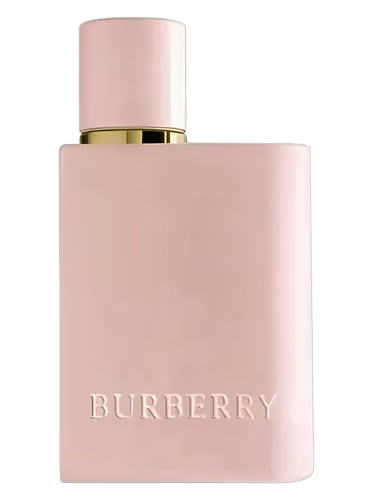
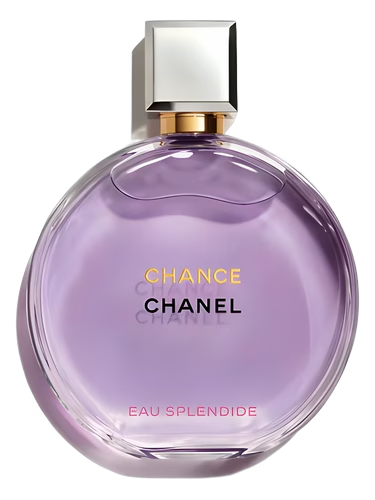
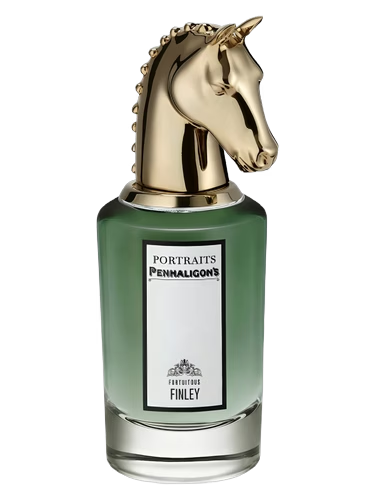
What is Bird Cherry?
Bird cherry is a flowering tree native to Europe and northern Asia, prized in perfumery for its delicate white blossoms that offer a complex, sweet floral scent with distinct bitter almond facets.What does Bird Cherry smell like?
It presents a sophisticated, slightly narcotic aroma featuring a creamy floral core, warm musky nuances, and a characteristic bitter-sweet undertone of almond and cherry.How is Bird Cherry essence extracted?
Modern perfumery primarily uses solvent extraction to produce an absolute, though advanced methods like supercritical CO2 extraction are also used to capture its delicate, heat-sensitive aromatic molecules.What are some top perfumes featuring Bird Cherry?
Notable fragrances include Serge Dumonten Summer Rain, Siordia Parfums Rostov Sur-Le-Don, OsmoGenes Perfumes Neon Lilac, and Kamila Robinson Krasnodar in Flora.When is Bird Cherry in season?
The tree typically blooms in early to mid-spring, between April and May, producing prolific clusters of fragrant almond-scented flowers.