Fragrance Notes Are Layers Of Scent That Are Layered To Form The Final Fragrance. Fragrance Notes Are Categorised Into Three Main Elements Based On How Long They Take To Evaporate, And How Long They Typically Last Following Application: Top Notes, Heart Notes And Base Notes.
Bigarade
Bigarade, or bitter orange, offers a zesty, bright, and slightly metallic citrus note with complex green and herbaceous undertones. It's less sweet and more tart than sweet orange, providing a refreshing, uplifting bitterness often used in top notes to add sparkle and a classic, clean feel, particularly in Eaux de Cologne.

Origin & Extraction Of Bigarade
Bigarade, derived from the bitter orange tree (Citrus aurantium), has a deeply rooted history in perfumery, particularly within the Mediterranean tradition. The essential oil, distilled from the peel of the fruit, became foundational to the classic Eau de Cologne structure formulated in the early 18th century. Prized for its sharp, zesty, and non-sweet citrus profile, Bigarade was essential in creating the refreshing, clean, and invigorating opening that defined these early colognes, securing its place as an enduring cornerstone of the fresh fragrance category.
In modern perfumery, Bigarade remains highly valued, not only for its historical significance but also for its complex aromatic profile, which often includes subtle green, herbaceous, and metallic undertones. Contemporary perfumers utilize bitter orange essence (alongside its derivatives petitgrain and neroli) to provide a sophisticated, luminous, and enduring opening that is distinct from sweeter citrus notes. It is frequently employed in niche and high-end compositions to anchor the top notes, adding complexity and preventing the fragrance from becoming overly fleeting.
Bigarade, or bitter orange, is a central note in classic perfumery, serving as the essential building block for traditional Eau de Cologne compositions due to its bright, zesty, and subtly bitter freshness. Its role is often to provide an immediate, invigorating burst that defines the opening phase of a fragrance. The timeless quality of Bigarade ensures it remains a staple, offering complexity that prevents citrus compositions from becoming overly simple or sweet.
- One of the most celebrated modern uses of the Bigarade note is in Frédéric Malle's **Bigarade Concentrée**, where the perfumer sought to capture the entire bitter orange tree—the fruit, the leaf, and the flower—creating an exceptionally pure and long-lasting expression of the ingredient.
- It is also foundational to the classic structure of many Guerlain Eaux de Cologne, like **Eau de Guerlain**, and modern interpretations like Hermès' line of Colognes, such as **Eau de Mandarine Ambrée**, where Bigarade provides a sharp, green counterpoint to sweeter notes.
In contemporary niche perfumery, Bigarade is prized for its ability to cut through heavier compositions and add a sophisticated, natural luminosity. Its green and herbaceous undertones make it particularly versatile, allowing it to blend seamlessly with everything from delicate florals to deep woody bases. This complexity elevates simple citrus openings into refined statements.
Bigarade's presence is key in high-end compositions where natural, lasting freshness is desired. A prime example is Tom Ford's **Neroli Portofino**, which relies heavily on the bitter orange facets (Bigarade, Neroli, and Petitgrain) to evoke the Italian Riviera with a luxurious, crisp, and clean Mediterranean scent profile. Its enduring appeal lies in its clean bitterness and zesty brightness, securing its reputation as the most sophisticated citrus note in the perfumer's palette.
Sustainability Of Bigarade
Sustainability of Bigarade
- Promoting a circular economy by repurposing urban harvests and industrial waste into high-value products like artisanal jams, liqueurs, and bio-based food packaging
- Adoption of organic farming practices and integrated pest management to ensure fruits and leaves are untreated and free from pesticides
- Implementing energy-efficient technologies such as hybrid solar drying systems and photovoltaic panels to reduce the carbon footprint of processing operations
- Establishing cooperatives and community-based initiatives to ensure fair pricing, stable income, and socio-economic resilience for small-scale farmers and workers
- Supporting biodiversity conservation through the revival of local traditional varieties and the creation of agroecological gardens that integrate citrus with reforestation efforts
- Utilizing molecular distillation and sustainable extraction methods to maximize yield while minimizing environmental impact and resource consumption
Trivia
Bigarade, the oil of the Seville orange, is the primary ingredient in the original 17th-century Eau de Cologne and is uniquely obtained through molecular distillation to enhance its bitter, zesty purity.
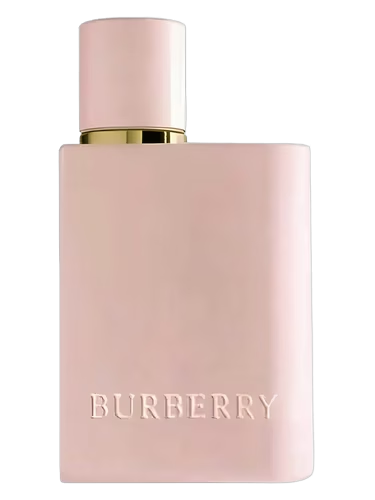
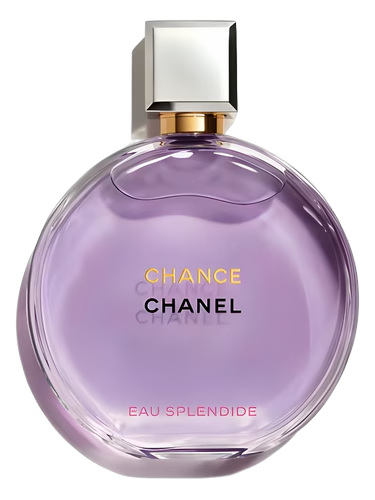
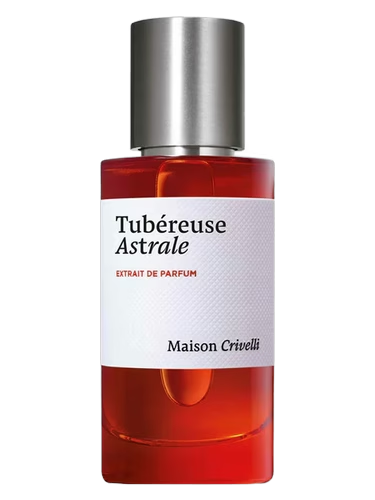
Most Popular Scents Using Bigarade
What is Bigarade?
Bigarade is the essential oil derived from the bitter orange tree, Citrus aurantium, and is a foundational ingredient in classic Eau de Cologne formulations.What does Bigarade smell like?
It offers a zesty, bright, and slightly metallic citrus note with complex green and herbaceous undertones, providing a refreshing bitterness that is less sweet than common orange.How is Bigarade essence extracted?
The essence is primarily obtained through cold expression of the fruit's outer peel, though modern techniques like molecular distillation and supercritical carbon dioxide (scCO2) extraction are also used to enhance purity.What are some top perfumes featuring Bigarade?
Notable fragrances include Frederic Malle Bigarade Concentrée, Creed Citrus Bigarade, Le Labo Bigarade 18 Hong Kong, Diptyque Eau des Sens, and Jo Malone Orange Bitters.When is Bigarade in season?
The bitter orange tree is traditionally in season between April and May, particularly in regions like the French Riviera, where its flowers and peel are harvested at peak aromatic potential.