Fragrance Notes Are Layers Of Scent That Are Layered To Form The Final Fragrance. Fragrance Notes Are Categorised Into Three Main Elements Based On How Long They Take To Evaporate, And How Long They Typically Last Following Application: Top Notes, Heart Notes And Base Notes.
Banksia Australian
Banksia offers an exotic, complex profile, often characterized by its nectar note. It blends aromatic, woody, and spicy facets with balsamic Australian eucalyptus and zesty grapefruit. Floral nuances like Monoi and Boronia soften the composition, finishing with the deep, embracing warmth of Australian sandalwood and cedar.

Origin & Extraction Of Banksia Australian
The Banksia note, derived from the Australian native flora, does not share the long classical history of notes like rose or jasmine. As a unique and exotic scent profile, its use in fine perfumery is largely a modern trend. It is part of a broader movement, beginning primarily in the late 20th and early 21st centuries, where perfumers have increasingly explored materials outside the traditional European palette, particularly focusing on unique Australian botanicals like Sandalwood, Boronia, and Eucalyptus, to introduce novel aromatic complexity. Banksia itself is often characterized by its woody, nectarous, and slightly spicy facets, reflecting its diverse nature in the wild.
The Banksia note's relevance in contemporary perfumery is its ability to blend aromatic, earthy, and sweet facets, offering a distinctively Australian warmth and complexity. It is valued by niche and artisanal brands seeking to create fragrances with a strong geographical identity and unique exotic appeal. By combining its natural woody and spicy character with floral and citrus nuances (as mentioned in its odor profile), Banksia serves as an anchor in modern, complex compositions, offering superior longevity and a departure from more conventional floral and oriental structures.
Extraction Methods of Banksia
Historically, extracting seeds from the woody follicles of Banksia cones was achieved through traditional manual and heat-based techniques. Methods often involved placing cones on open fires or using a Bunsen burner to melt the resin and crack the follicles. Another traditional approach included the "soak and heat" cycle, where cones were submerged in water for several hours and then dried in a warm oven, a process that could be repeated until the seeds were released. Manual extraction using tweezers or tapping the cooled cones was then used to retrieve the winged seeds from their separators.
Modern and advanced methods have refined these processes for both commercial nursery production and scientific research. Precise heat application is now standardized, such as placing cones in an oven at 120-130°C for one hour or 200°C for ten minutes to ensure uniform opening without damaging seed viability. For fragrance and cosmetic applications, innovative cellular extraction technology is utilized to capture water-soluble phyto-compounds directly from the flowers, maintaining the natural molecule profile in a stable liquid format. Additionally, for ecological restoration, direct seeding machinery and specialized nursery germination trials are employed to handle large volumes of extracted seed efficiently.
The Banksia Australian note, prized for its exotic, woody, nectarous, and slightly spicy profile, is predominantly featured in niche and artisanal perfumery, particularly in creations that emphasize Australian botanicals. The brand CHRISTOPHER HANLON® has extensively explored this ingredient, dedicating fragrances to capture its unique scent profile.
- The Banksia note is utilized across several of the brand's scents, including Royal Banksia, Black Cockatoo, and Melbourne Amber Musk.
In these compositions, Banksia serves to anchor the scent with a complex Australian warmth, often blending its natural woody and spicy character with other unique notes like Honey Grevillea, Australian Desert Oak, and Borooloola Desert Lime, as seen in Royal Banksia. This approach provides a unique depth and geographic identity, distinguishing these fragrances from more conventional European floral or oriental structures.
- Other notable fragrances from the house, such as Royal Sovereign and Gold Rush, also feature Banksia, confirming its role as a key element in the brand's palette for creating modern, complex, and distinctively Australian fresh compositions.
While the Banksia note is not a component of the classical perfume repertoire like Rose or Jasmine, its growing inclusion in contemporary scent design reflects a trend toward using novel, natural materials that offer superior longevity and complex aromatic blends, moving beyond the traditional European palette.
Sustainability Of Banksia Australian
Sustainability of Australian Banksia
- Promoting environmental excellence through the National Banksia Sustainability Awards, Australia's longest-running prestigious awards program that recognizes and encourages innovative sustainable practices
- Aligning organizational goals with the United Nations Sustainable Development Goals (SDGs) to provide a strategic framework for businesses to assess and improve their social and environmental impact
- Supporting a circular economy by celebrating pioneers like BlockTexx, which utilizes world-first technology to recycle blended fabrics and divert textile waste from landfills
- Fostering biodiversity and nature-based solutions by showcasing initiatives like the Mulloon Institute’s large-scale catchment restoration and urban reforestation projects
- Advancing social sustainability and inclusion by partnering with organizations to champion diversity, equity, and the empowerment of First Nations communities through ethical business practices
- Encouraging sustainable building and design through government-backed initiatives like Banksia House, which utilizes smart cooling technology and native landscaping to reduce energy consumption
Trivia
Australian banksia seed pods are so resilient that they are designed to withstand bushfires, often requiring the intense heat of the flames to open their "eyes" and release their seeds for re-germination.
Most Popular Scents Using Banksia Australian
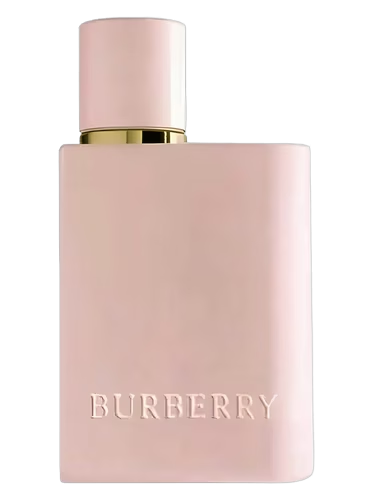
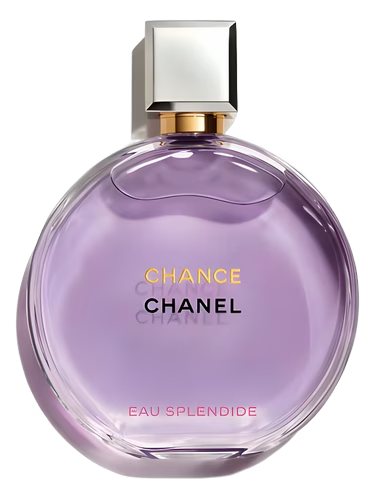
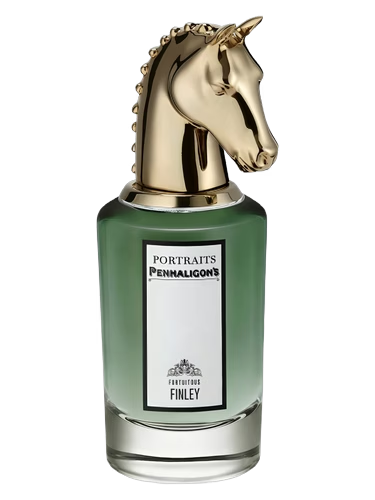
What is Banksia Australian?
Banksia is a note derived from a genus of Australian wildflowers, known for its exotic, woody, and nectarous aromatic profile used in modern niche perfumery.What does Banksia Australian smell like?
It offers a complex scent blending sweet nectar and floral nuances with aromatic, woody, and spicy facets, often accented by notes of eucalyptus, grapefruit, and sandalwood.How is Banksia essence extracted?
In modern perfumery, innovative cellular extraction technology is used to capture water-soluble phyto-compounds from the flowers, while traditional methods involve heating the woody cones to release seeds.What are some top perfumes featuring Banksia Australian?
Notable fragrances include Christopher Hanlon Royal Banksia, Locherber Milano Banksia, MetaScent Fire Banksia, and Christopher Hanlon Black Cockatoo.When is Banksia in season?
Banksias exhibit a diverse blooming cycle across all four seasons, with many species reaching their flowering peak during autumn and winter.