Fragrance Notes Are Layers Of Scent That Are Layered To Form The Final Fragrance. Fragrance Notes Are Categorised Into Three Main Elements Based On How Long They Take To Evaporate, And How Long They Typically Last Following Application: Top Notes, Heart Notes And Base Notes.
Astragalus
Astragalus, derived from the Milk Vetch plant, provides an earthy, subtly sweet, and complex herbaceous aroma, often evoking dried hay or a light, nutty legume quality. It is used to ground floral compositions, offering a natural, slightly balsamic depth and a dry, sophisticated texture to the fragrance base.

Origin & Extraction Of Astragalus
Astragalus, derived from the large plant genus often referred to as Milk Vetch, does not possess a long, traditional history as a primary note in Western fine perfumery like classical ingredients such as rose or sandalwood. Historically, various species of Astragalus were primarily valued for their medicinal properties, particularly in traditional Chinese medicine (where some species are known as Huang Qi) for their adaptogenic qualities. The gummy resin derived from some species, known as gum tragacanth, was also used historically as a fixative and emulsifier, but its specific aroma was not celebrated for scent composition until modern times.
The contemporary use of Astragalus as a distinct aromatic note is relatively niche, reflecting a trend toward incorporating natural, earthy, and herbaceous textures to provide depth and complexity to modern compositions. Perfumers utilize the extract, which conveys a dry, subtly sweet, and hay-like quality, often with nutty or balsamic undertones, to anchor more volatile floral or green accords. It serves as a sophisticated, grounding ingredient, lending a dry, naturalistic foundation that complements floral arrangements, particularly in artisanal or niche fragrances seeking a unique, slightly savory herbal dimension.
Extraction Methods of Astragalus
Historically, the extraction of active compounds from Astragalus roots, such as polysaccharides and saponins, primarily relied on traditional water decoction. This ancient method involves cleaning, drying, and crushing the roots before boiling them in water multiple times to create a concentrated liquid. For more medicinal applications, traditional techniques also included simple infusions and the preparation of ethanolic tinctures, where dried roots were soaked in alcohol for extended periods to capture the plant's therapeutic essence.
Modern commercial and laboratory production has shifted toward more efficient and targeted technologies. Current standard practices often utilize microwave-assisted extraction (MAE) and ultrasonic extraction, which use thermal effects and cavitation to rupture plant cell walls, significantly shortening extraction time and increasing yield. Recent advancements include enzymatic extraction—using specific enzymes like cellulase to break down plant fibers under mild conditions—and semi-bionic extraction, which simulates the drug transport process through the human gastrointestinal tract. To achieve high purity, such as for Astragaloside IV, advanced processes now incorporate macroporous resin columns, activated carbon adsorption, and aqueous two-phase systems (ATPS) to isolate specific molecules from the crude extract.
Astragalus, a note valued for its earthy, dry, and herbaceous profile (often likened to dried hay or a subtle balsamic depth), is primarily found in niche and artisanal fragrances that seek a grounding, naturalistic foundation. It provides complexity far removed from mainstream sweetness, bridging volatile top notes with woody or resinous bases. This quality makes it perfect for compositions aiming for a sophisticated, understated natural scent profile.
- A notable use of a related Astragalus facet is sometimes found in the earthy dry-downs of fragrances like **L'Air du Désert Marocain** by Tauer Perfumes, where a dry, hay-like accord contributes to the vast, arid landscape captured by the scent.
The contemporary appeal of Astragalus lies in its ability to introduce a dry, slightly savory herbal dimension to floral or amber compositions, preventing them from becoming overly cloying or simple. While Astragalus itself is a specific ingredient name, its associated aromatic qualities—particularly the dry, sweet, and nutty tones—are often synthesized or blended using other materials to achieve a similar effect in complex natural fragrances.
- In designer perfumery, while often unlisted as a primary note, the dry, earthy texture characteristic of Astragalus's profile can be perceived in the background of certain modern aromatic-fougeres to enhance longevity and depth.
Due to its specialized and niche use, Astragalus is less frequently featured in widely available designer perfumes and more commonly embraced by houses focused on botanical realism and unusual textures. It serves to deepen and stabilize volatile elements, functioning as a subtle, sophisticated fixative that supports the main theme while adding an inimitable dry, herbaceous character to the base of the perfume.
Sustainability Of Astragalus
Sustainability of Astragalus
- Promoting sustainable harvesting practices of the roots, which are the primary source for perfumery, to ensure the long-term health of natural ecosystems
- Advancing cultivation in controlled environments and arid regions to meet global demand without depleting wild populations or harming biodiversity
- Supporting the resilience of rural economies in major growing regions like China and Mongolia by maintaining traditional agricultural practices and 700-year-old heritage crafts
- Implementing organic farming standards and integrated management to reduce chemical reliance and protect soil health in the harsh continental climates where it thrives
- Encouraging a circular economy by utilizing by-products for animal feed, traditional medicine, and agricultural fertilizers to ensure zero-waste production
Trivia
The name Astragalus is derived from the Greek word astragalos, meaning ankle bone, because the shape of the plant's dried root pieces was thought to resemble that specific bone.
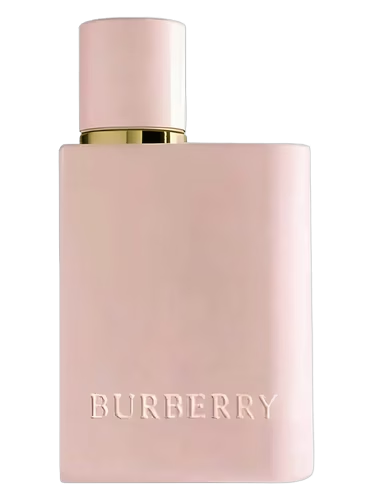
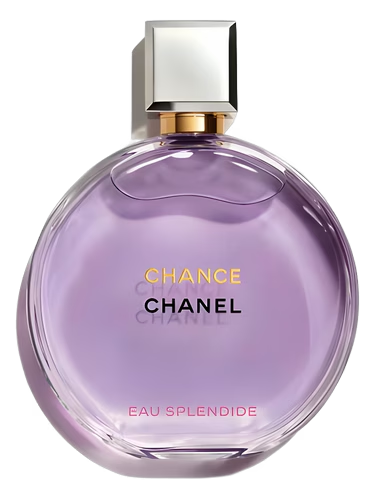
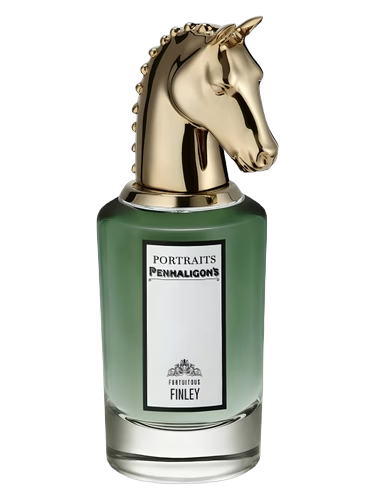
Most Popular Scents Using Astragalus
What is Astragalus?
Astragalus, also known as Milk Vetch or Huang Qi, is a large genus of flowering plants in the legume family, primarily valued in perfumery for its earthy and herbaceous root extract.What does Astragalus smell like?
It features a dry, subtly sweet, and complex herbaceous aroma often compared to dried hay, with light nutty, balsamic, and savory undertones.How is Astragalus essence extracted?
In modern perfumery, the aromatic material is primarily obtained through the steam distillation of the plant's dried roots.What are some top perfumes featuring Astragalus?
While a niche note, its characteristic dry, hay-like profile is prominently featured in Sanrio Pochacco and related facets can be found in the dry-down of L'Air du Désert Marocain by Tauer Perfumes.When is Astragalus in season?
The plant flourishes during the summer with flowers blooming from midsummer to late autumn, while the roots are typically harvested in the fall after the plant has matured for at least two to four years.