Fragrance Notes Are Layers Of Scent That Are Layered To Form The Final Fragrance. Fragrance Notes Are Categorised Into Three Main Elements Based On How Long They Take To Evaporate, And How Long They Typically Last Following Application: Top Notes, Heart Notes And Base Notes.
Asian Clintonia
Asian Clintonia offers a delicate, green-white floral profile, reminiscent of lily of the valley or cyclamen. It is characteristically fresh, airy, and slightly dewy with subtle aquatic nuances and a gentle, sweet soapiness, providing an ethereal, clean luminosity to compositions.

Origin & Extraction Of Asian Clintonia
Asian Clintonia, a delicate flower with a profile reminiscent of lily of the valley or cyclamen, is a highly specialized and relatively modern note in perfumery. The plant, native to East Asia, does not have a long history as a traditional aromatic material like roses or jasmine. Its usage in fine fragrance is tied to 20th and 21st-century advancements in headspace technology and synthetic notes, which allowed perfumers to capture the light, green-white, and slightly dewy essence of delicate, non-extractable flowers.
The relevance of the Asian Clintonia note today lies in its ability to introduce a unique, ethereal, and clean luminosity to compositions, moving beyond the standard muguet or cyclamen accords. Perfumers utilize its subtle aquatic and sweet soapiness to create highly transparent, fresh, and airy compositions, often featured in niche, minimalist, and contemporary spring-themed fragrances where a gentle, naturalistic white floral complexity is desired.
Extraction Methods of Asian Clintonia
The extraction of aromatic and bioactive compounds from Asian Clintonia (Clintonia udensis) traditionally relies on maceration and solvent-based techniques. Historically, simple infusion or soaking in ethanol or water was used to capture the plant's essence, particularly from its blue-black berries and rhizomes. These conventional methods often require extended periods to allow the solvent to penetrate the plant tissues and dissolve the target phytochemicals.
Modern extraction developments have shifted toward more efficient, green technologies such as ultrasound-assisted extraction (UAE) and microwave-assisted extraction (MAE). These contemporary methods utilize mechanical or electromagnetic energy to disrupt plant cell walls more effectively than simple soaking, significantly reducing extraction time and solvent consumption while increasing the yield of delicate compounds. Recent research also explores the use of Deep Eutectic Solvents (DES) as an eco-friendly alternative to traditional chemical solvents, providing a sustainable pathway for isolating the plant's unique nutritional and aromatic profile.
Asian Clintonia, known for its delicate, green-white floral profile reminiscent of lily of the valley, is a note predominantly found in contemporary and niche fragrances that seek an ethereal and clean luminosity. Because it is a specialized note, often captured using modern headspace technology rather than traditional extraction, its inclusion signifies a focus on transparent, airy compositions. Its effect is to provide a gentle, dewy freshness that lifts a composition without overpowering it.
- Among the fragrances utilizing this note to achieve a sense of delicate purity is **Dior's Escale à Portofino**, where subtle floral notes are woven into a bright citrus structure, giving the scent a sophisticated, clean feeling.
- Another modern example is **Acqua di Parma's Gelsomino Nobile**, which uses this light, green-tinged floral profile to accentuate the freshness of jasmine and cyclamen, creating an almost crystalline effect.
- The note’s subtle aquatic nuances also make it suitable for minimalist scents, such as those by Byredo or Jo Malone, who often layer delicate, nature-inspired notes to evoke specific, fresh environments.
The primary function of Asian Clintonia in modern perfumery is to bridge the sharp, zesty opening notes with a clean, soft heart. It prevents the fragrance from becoming too sweet or heavy, maintaining a 'just-showered' elegance. Its usage signals an intention to move beyond classic white florals, opting for a gentle, naturalistic complexity suitable for spring and summer wear, where freshness and transparency are key to the fragrance's appeal.
While not a classical note like Rose or Jasmine, the growing appreciation for clean, green-white florals ensures Asian Clintonia's continued role in niche perfumery. It appeals to connoisseurs looking for subtlety and sophistication, appearing in exclusive lines and limited editions that celebrate delicate, hard-to-capture natural scents. Its unique blend of airiness and sweet soapiness offers perfumers a versatile tool for crafting highly refined, modern compositions.
Sustainability Of Asian Clintonia
Sustainability of Asian Clintonia
- Promoting biodiversity conservation by protecting the native alpine and temperate forest habitats of the Himalayas and East Asia where this sole Asian Clintonia species thrives
- Supporting ecosystem health through the preservation of underground rhizome systems that stabilize forest floors and enable the formation of natural colonies
- Encouraging sustainable wild harvesting practices for local food use to ensure the long-term viability of wild populations in regions like China and India
- Advancing botanical research into polyploidization and cytotype diversity to better understand plant evolution and maintain genetic resilience within the species
- Utilizing organic-rich, acid soil management and moisture-retention techniques in cultivation to mimic natural forest conditions and reduce the need for synthetic inputs
Trivia
Clintonia udensis, also known as the bead lily, produces striking dark blue berries that are of such an intense, unnatural shade of blue that botanists traditionally warn they should be avoided as poisonous, despite the plant's young leaves being used as a wild food.
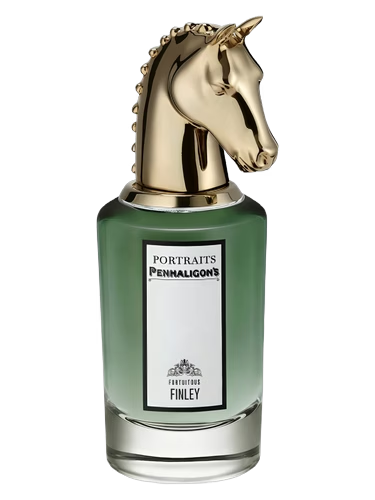
Most Popular Scents Using Asian Clintonia


What is Asian Clintonia?
Asian Clintonia, or Clintonia udensis, is a delicate perennial flower native to East Asia and the Himalayas, used in modern perfumery to provide a fresh, green-white floral profile.What does Asian Clintonia smell like?
It offers a characteristically fresh and airy aroma reminiscent of lily of the valley or cyclamen, featuring subtle aquatic nuances and a gentle, sweet soapiness.How is the Asian Clintonia note extracted?
Because the flowers are delicate and non-extractable by traditional means, the note is typically captured using modern headspace technology or recreated through synthetic accords.What are some top perfumes featuring Asian Clintonia?
While not always a primary note, its profile is used to achieve purity in fragrances like Dior's Escale a Portofino and Acqua di Parma's Gelsomino Nobile.When is Asian Clintonia in season?
The plant typically flowers during the summer months, specifically from July to August, before developing its signature dark blue berries in late summer and autumn.