Fragrance Notes Are Layers Of Scent That Are Layered To Form The Final Fragrance. Fragrance Notes Are Categorised Into Three Main Elements Based On How Long They Take To Evaporate, And How Long They Typically Last Following Application: Top Notes, Heart Notes And Base Notes.
Argan
Argan oil used in perfumery is often filtered and deodorized, resulting in a nearly odorless profile or a soft, subtle, almost fruity scent. Unrefined Argan oil carries a distinctive light, nutty, and earthy aroma due to the kernel's natural scent. It is valued more for its cosmetic properties than a prominent fragrance note.

Origin & Extraction Of Argan
Argan oil originates from the Argan tree endemic to Morocco and has historically been used for food, cosmetics, and traditional medicine. Its widespread use in high-end cosmetic and hair care products in the late 20th and early 21st centuries, where it is valued for its nourishing and luxurious properties, is what primarily introduced the "Argan scent profile" into the cultural consciousness, linking it to themes of richness and exotic luxury.
In fine perfumery, the Argan note is often an accord—a synthetic recreation—as the refined natural oil used in cosmetics is frequently odorless or nearly so. When included, this note is used to impart a sense of warm, nutty, and creamy texture, often complementing oriental, amber, or gourmand compositions. It functions less as a prominent, singular scent and more as a supporting note that enhances the perception of richness, mirroring its modern association with high-quality, comforting body care products.
Extraction Methods of Argan
The extraction of argan oil is a meticulous process that begins with harvesting the fruit, typically gathered from the ground in summer once ripe. Historically, this has been a labor-intensive manual task performed by Berber women in Morocco. The traditional method involves removing the dry pulp, cracking the hard-shelled nuts between two stones to retrieve the kernels, and grinding them with a stone mill. For culinary oil, kernels are roasted before grinding; for cosmetic use, they remain raw. This paste is then hand-kneaded with water to separate the oil, a process that can take up to 20 hours of labor for a single liter.
Modern commercial production has evolved to improve efficiency, purity, and shelf life through mechanical cold pressing. In this updated process, while nut cracking may still be done manually to ensure kernel quality, the oil is extracted using mechanical stainless-steel presses. These machines eliminate the need for adding water, resulting in a more stable oil with lower water content and less risk of bacterial contamination. Advanced filtration systems are then used to achieve the desired clarity and remove sediment. Additionally, some industrial-scale operations utilize chemical solvent extraction (typically with hexane) to maximize yield, though this method is often criticized for reducing the oil's nutrient density and leaving chemical residues.
Argan oil, while often subtle and used more for its rich texture than its scent in perfumery, adds a distinctive nutty and creamy warmth to modern oriental and gourmand compositions. A recent example is Fleur de Santal by Attar Collection (2023), a unisex fragrance where Argan likely contributes a velvety backdrop, enhancing the creamy facets of sandalwood and other oriental notes to create a rich, enveloping scent experience.
- ***
In the independent and niche market, Argan is sometimes highlighted for its luxurious, soft texture. Sweet Xplosion by Lorenzo Pazzaglia (2023) utilizes Argan in a gourmand context, where its subtle nutty-creamy profile can smooth the transition between intense sweet notes and richer base notes like vanilla or musk, giving the overall composition a sense of opulence and depth. Demeter Fragrance even created a straightforward scent named Argan (2018), focusing purely on the simple, light, and earthy aroma of the oil.
- ***
While not always listed as a central note, Argan often appears in body mists, hair mists, and fragrance layers, leveraging its association with high-quality Moroccan oil. For instance, in products like Orange Blossom Hair Mist by Jo Malone London (2022) or Golden Honey & Argan Oil by Blue Scents (2024), the oil's presence is primarily to impart a rich, conditioning texture alongside a gentle, warm aromatic complement, rounding out the sharper citrus or floral notes with a hint of subtle, earthy richness.
Sustainability Of Argan
Sustainability of Argan
- Preserving the argan forest as a UNESCO-protected biosphere reserve to prevent Sahara Desert encroachment and combat desertification
- Empowering rural Moroccan women through the establishment of producer cooperatives that ensure fair wages, economic independence, and social resilience
- Protecting local biodiversity and soil health through the argan tree’s deep root systems, which provide natural stabilization and moisture retention
- Adoption of organic and wild-harvesting practices that maintain genetic diversity and avoid the use of chemical fertilizers or pesticides
- Implementation of reforestation and conservation initiatives, including the planting of thousands of new trees to counteract overexploitation and climate change
- Transitioning to eco-friendly production methods, such as the use of solar-powered processing units to reduce the carbon footprint of oil extraction
Trivia
In Morocco, argan trees are often seen with goats standing on their branches; these goats climb the trees to eat the fruit, and historically, the undigested pits they excreted were collected by locals to be pressed into the valuable oil.
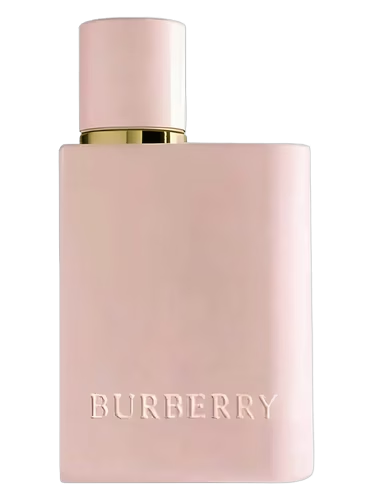
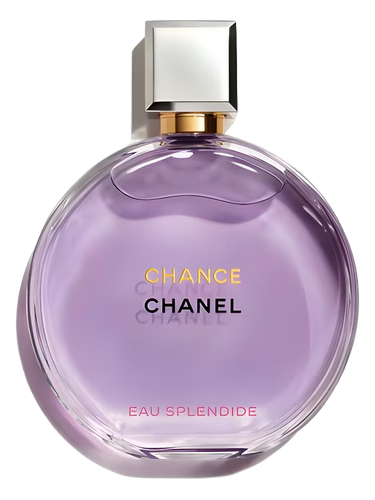
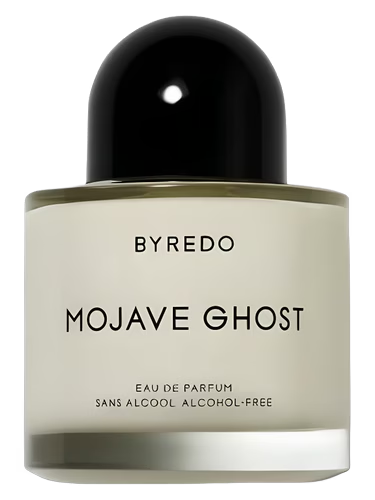
Most Popular Scents Using Argan
What is Argan in perfumery?
Argan is a fragrance note inspired by the oil of the Argan tree, primarily used as an accord to impart a warm, nutty, and creamy texture to oriental and gourmand compositions.What does Argan smell like?
While refined oil is often nearly odorless, the Argan note in fragrances typically features a soft, subtle, and nutty profile with creamy, earthy, and sometimes lightly fruity undertones.How is Argan essence extracted?
The oil is primarily obtained through mechanical cold pressing of the raw kernels retrieved from the fruit of the Argan tree.What are some top perfumes featuring Argan?
Notable fragrances include Attar Collection Fleur de Santal, Lorenzo Pazzaglia Sweet Xplosion, Demeter Argan, and Jo Malone London Orange Blossom Hair Mist.When is Argan in season?
The primary harvest for Argan fruit occurs during the hot summer months, specifically between July and September, after the fruits have reached full maturity.