Fragrance Notes Are Layers Of Scent That Are Layered To Form The Final Fragrance. Fragrance Notes Are Categorised Into Three Main Elements Based On How Long They Take To Evaporate, And How Long They Typically Last Following Application: Top Notes, Heart Notes And Base Notes.
Apple Juice
A bright, juicy, and sweetly refreshing aroma capturing the essence of freshly pressed apples. It often conveys a crisp, natural apple character with nuanced green and slightly tart undertones, reminiscent of cider. This fruity-green note adds a cheerful, aqueous freshness and natural volume, making it versatile in floral and fruit fragrances.

Origin & Extraction Of Apple Juice
While the "Apple Juice" note does not possess the long classical history of notes like Bergamot or Neroli, its relevance to perfumery surged with the rise of modern fruity-floral and gourmand categories in the late 20th and early 21st centuries. Perfumers began seeking realistic, recognizable fruit aromas to convey youthfulness, vibrancy, and a "mouth-watering" quality. The clean, crisp, and refreshing nature of apple, reminiscent of fresh juice, quickly became a popular synthetic accord to provide a bright, immediate lift in casual and mass-market fragrances.
The use of a prominent apple accord was famously popularized by fragrances like Donna Karan's Be Delicious (2004), which cemented the note's place as a modern, iconic fruity top note. Today, the Apple Juice note is valued for its versatility—it can be used to inject simple sweetness into summery fragrances, or combined with spices and woods in niche perfumery to evoke comforting, sophisticated autumnal qualities, demonstrating its evolution beyond a simple, fleeting top note.
Extraction Methods of Apple Juice
The primary method for extracting apple juice is a two-step process of maceration and pressing. Historically, apples were crushed using manual tools like a pestle and mortar or simple stone mills to create a pomace or mash. This mash was then placed in a barrel-shaped cage or wrapped in cloth and squeezed using wooden piston presses or weighted boards. In some traditional home methods, freezing and thawing the fruit was used to break down the cell structure and make the hand-pressing process more efficient.
In modern commercial production, high-speed grinders, hammer mills, or flail mills are used to create a finely milled mash. This mash is often treated with pectinase enzymes to break down cell walls and reduce viscosity, which can increase the juice yield by at least 5%. The juice is then extracted using powerful hydraulic, belt, or screw presses that separate the liquid from the solids (pomace). Large-scale operations also utilize vacuum evaporation to create apple juice concentrate by removing up to 70% of the water content.
Recent technological advancements have introduced alternative extraction and preservation methods such as decanter centrifuges, which allow for juice extraction under an inert gas blanket to prevent oxidation and preserve natural color. Other modern techniques include ultrafiltration for high-level clarification and thermosonication—the combination of ultrasound treatment with moderate heat—to deactivate microorganisms while maintaining the juice's nutritional value and polyphenol content more effectively than traditional high-heat pasteurization.
Apple Juice, with its crisp, sweetly refreshing, and slightly tart aroma, gained significant prominence in modern perfumery by lending a youthful, vibrant energy to compositions. The note's breakthrough moment is often attributed to the scent of the famous green apple fragrance, which captured the essence of the fruit and set a trend for photorealistic fruity notes.
One of the most globally recognized fragrances featuring this uplifting note is **DKNY Be Delicious**. This iconic scent captures the crispness of a juicy green apple, blending it with floral and woody notes to create a cheerful and instantly recognizable aroma that has inspired countless other fruity-floral perfumes. The note provides a unique aqueous sweetness that is both invigorating and widely appealing.
While often used in fresh, youthful scents, the apple note's versatility allows it to transition into more sophisticated or masculine compositions. For example, in fragrances like **Boss Bottled**, the apple note contributes a bright, modern freshness to an otherwise warm, spicy, and woody structure, demonstrating its ability to add a sharp, clean opening that enhances depth without overpowering the composition.
Sustainability Of Apple Juice
Sustainability of Apple Juice
- Utilizing upcycling by extracting olfactive components from leftover apple juice pulp to create premium fragrance ingredients like Apple Oil Orpur
- Promoting a circular economy by repurposing post-extraction apple pulp as nutritious animal feed to ensure minimal waste
- Developing eco-friendly bioplastics and organic monomers from apple waste products like peels and pomace to replace petrochemical-based packaging
- Adopting sustainable food processing technologies like thermosonication to reduce energy consumption and preserve bioactive compounds without traditional heat treatments
- Supporting local apple growers and agricultural communities through partnerships that secure farmer livelihoods and promote sustainable land management
Trivia
Despite being a fruit, the crisp apple note used in many modern perfumes is often a synthetic "fantasy" ingredient, yet the apple's botanical relative is actually the rose.
Most Popular Scents Using Apple Juice
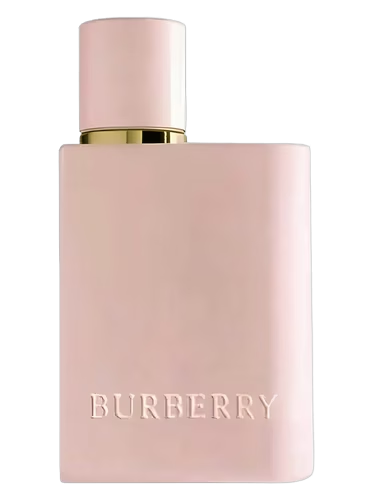
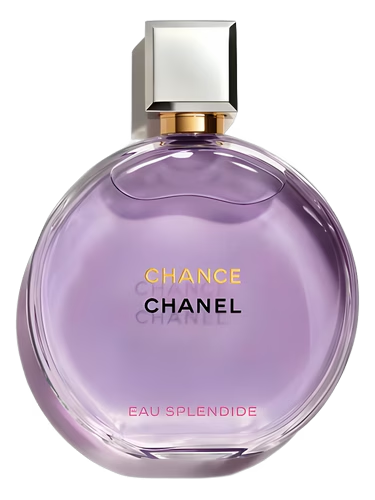
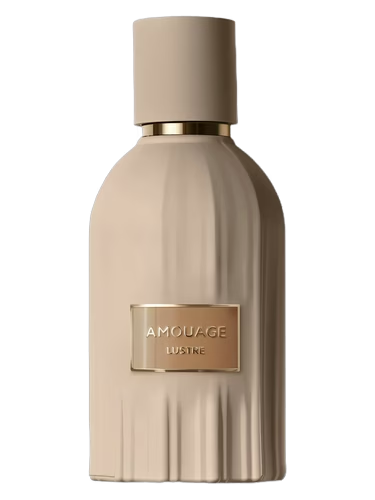
What is the Apple Juice note in perfumery?
It is a modern fragrance accord used to convey youthfulness and vibrancy, gaining significant popularity in the early 21st century within the fruity-floral and gourmand categories.What does Apple Juice smell like?
It possesses a bright, juicy, and sweetly refreshing aroma that captures the essence of freshly pressed apples, often featuring crisp green facets and slightly tart, cider-like undertones.How is Apple Juice essence extracted?
The essence is typically obtained through a two-step process of maceration and pressing, where the fruit is milled into a mash and then squeezed using hydraulic or screw presses to extract the liquid.What are some top perfumes featuring the Apple Juice note?
Popular fragrances featuring this note include DKNY Be Delicious, Zara Applejuice, Boss Bottled, and Jo Malone Peony & Blush Suede.When is Apple Juice in season?
Apple juice is tied to the autumn harvest, with the most aromatic and flavorful fruit reaching peak maturity between late August and November.