Fragrance Notes Are Layers Of Scent That Are Layered To Form The Final Fragrance. Fragrance Notes Are Categorised Into Three Main Elements Based On How Long They Take To Evaporate, And How Long They Typically Last Following Application: Top Notes, Heart Notes And Base Notes.
Alstroemeria
Alstroemeria (Peruvian Lily) flowers are typically unscented, offering no natural fragrance. When utilized in perfumery, the note is conceptual, often rendered as an abstract, soft floral accord with emphasis on fresh, green, and slightly aqueous nuances, mimicking the flower's delicate visual appearance rather than a true odor.

Origin & Extraction Of Alstroemeria
The history of Alstroemeria, or Peruvian Lily, in perfumery is almost entirely contemporary, as the flower is naturally unscented. Unlike historically foundational notes such as rose or jasmine, which have been distilled for centuries, the Alstroemeria note is a conceptual abstraction. Its incorporation reflects a modern trend toward synthesizing abstract florals, capturing the visual elegance and delicate, fresh green nuances of the flower rather than a true natural odor. This synthesized note gained relevance as perfumers sought to create light, soft floral accords that convey innocence and delicate transparency, often emerging in the late 20th and early 21st centuries.
Since Alstroemeria lacks a natural fragrant oil for extraction, its note is engineered through headspace technology or synthetic reconstruction. This allows it to function as a sheer, slightly aqueous floral component in compositions, providing lift and an ethereal quality without dominating the structure. It is typically found in modern, minimalist floral, fresh, or aquatic fragrances, where it supports other notes by adding a fresh, dewy, and sophisticated 'green' texture rather than a heavy, traditional floral scent.
Extraction Methods of Alstroemeria
Historically, the aromatic compounds of delicate flowers like Alstroemeria were captured using enfleurage, a labor-intensive traditional method where fresh petals were placed on sheets of animal or vegetable fat. Over several days, the fat would absorb the flower's essential oils, and the process was repeated with fresh petals until the fat reached saturation. The resulting pomade was then treated with alcohol to separate the fragrant absolute. Maceration was also commonly employed, involving the soaking of plant material in warm carrier oils to extract the essence.
In modern perfumery, Alstroemeria is primarily processed through solvent extraction or supercritical CO2 extraction. Solvent extraction utilizes chemical solvents like hexane to dissolve the aromatic molecules, creating a waxy concrete that is further refined into a high-purity absolute. CO2 extraction is a more recent advancement that uses pressurized carbon dioxide in a supercritical state as a solvent; this method operates at lower temperatures, preserving the delicate, heat-sensitive volatile compounds of the flower and producing an extract that more accurately reflects the scent of the living plant without leaving chemical residues.
The Alstroemeria note, being a conceptual representation of a soft, green, and aqueous floral accord, is utilized primarily in modern perfumery to convey delicate freshness and transparency rather than a heavy, traditional floral scent. While few fragrances explicitly list "Alstroemeria" due to its unscented nature, the abstract, dewy floral character it embodies is key to achieving a light and ethereal structure in various compositions. This conceptual note allows perfumers to craft an atmosphere of subtle innocence and refinement.
- As an abstract floral and green element, Alstroemeria's profile is conceptually echoed in scents celebrated for their sheer, clean floral quality. Fragrances such as the original **L'Eau d'Issey** by Issey Miyake, known for its watery, transparent floralcy, employ similar principles of delicate reconstruction where an abstract white/green floral note provides lift without overwhelming sweetness or heaviness. This application places the Alstroemeria idea firmly in the realm of minimalist and aquatic-floral perfumes.
In contemporary niche perfumery, where sophisticated realism and unusual botanicals are explored, the Alstroemeria concept helps support photorealistic green compositions. While not an extractable note, the idea of Peruvian Lily's delicate, fresh, and slightly bitter-green visual is often translated to enhance the opening of modern, nature-focused scents. These fragrances—which might include airy florals or those focusing on sheer, newly-opened petals—leverage this profile to achieve maximum clarity and natural-smelling vitality, ensuring the top notes remain sparkling and vibrant.
The Alstroemeria note, being a conceptual representation of a soft, green, and aqueous floral accord, is utilized primarily in modern perfumery to convey delicate freshness and transparency rather than a heavy, traditional floral scent. While few fragrances explicitly list "Alstroemeria" due to its unscented nature, the abstract, dewy floral character it embodies is key to achieving a light and ethereal structure in various compositions. This conceptual note allows perfumers to craft an atmosphere of subtle innocence and refinement.
- As an abstract floral and green element, Alstroemeria's profile is conceptually echoed in scents celebrated for their sheer, clean floral quality. Fragrances such as the original L'Eau d'Issey by Issey Miyake, known for its watery, transparent floralcy, employ similar principles of delicate reconstruction where an abstract white/green floral note provides lift without overwhelming sweetness or heaviness. This application places the Alstroemeria idea firmly in the realm of minimalist and aquatic-floral perfumes.
In contemporary niche perfumery, where sophisticated realism and unusual botanicals are explored, the Alstroemeria concept helps support photorealistic green compositions. While not an extractable note, the idea of Peruvian Lily's delicate, fresh, and slightly bitter-green visual is often translated to enhance the opening of modern, nature-focused scents. These fragrances—which might include airy florals or those focusing on sheer, newly-opened petals—leverage this profile to achieve maximum clarity and natural-smelling vitality, ensuring the top notes remain sparkling and vibrant.
Sustainability Of Alstroemeria
Sustainability of Alstroemeria
- Promoting sustainable production by harvesting from the same perennial plant for several years, which reduces the need for frequent replanting and intensive crop protection
- Implementing organic pest management strategies, with 90% of protection being organic, and leveraging the plant's natural resistance to viruses and fungi
- Reducing energy consumption by maintaining lower average greenhouse temperatures (18 degrees Celsius) compared to other flower species
- Minimizing waste through a circular approach where flower waste is repurposed as natural fertilizer in the greenhouse
- Optimizing water usage as the species requires relatively little water and is drought-tolerant once established
- Lowering the environmental footprint of floral arrangements through its exceptional vase life (up to 14 days), which reduces the frequency of replacements and waste
- Advancing eco-friendly packaging by testing paper sleeves and utilizing recycled plastic that has a lower CO2 emission profile than certain biodegradable alternatives in specific waste systems
Trivia
Despite being commonly known as the Peruvian Lily, Alstroemeria is not a true lily and is entirely fragrance-free, making it a perfect floral choice for those with pollen allergies.
Most Popular Scents Using Alstroemeria
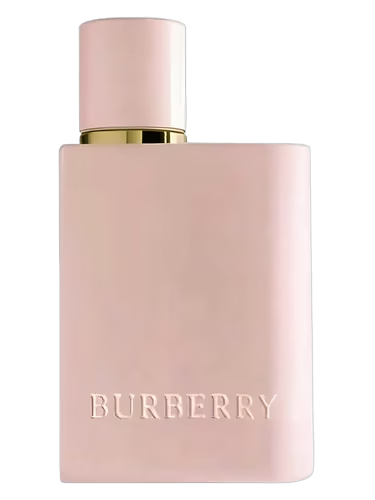
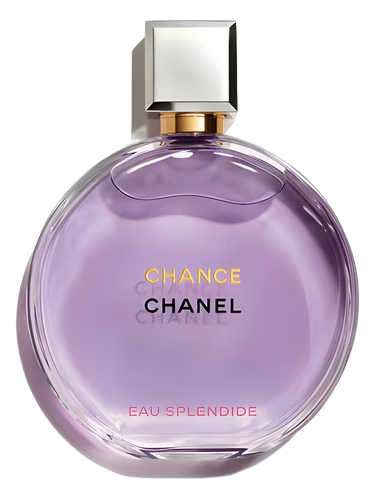
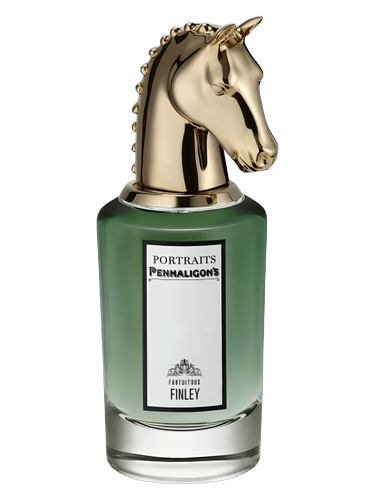
What is Alstroemeria in perfumery?
Alstroemeria, also known as the Peruvian Lily, is a conceptual fragrance note used to represent the visual elegance of the naturally unscented flower through abstract, soft floral accords.What does Alstroemeria smell like?
As a synthesized note, it features a fresh, green, and slightly aqueous aroma with dewy nuances, designed to convey delicate transparency and light floralcy.How is the Alstroemeria note created?
Since the flower lacks natural fragrant oil, the note is engineered using headspace technology or synthetic reconstruction to mimic its fresh, botanical profile.What are some top perfumes featuring Alstroemeria?
Fragrances that utilize this note or its conceptual profile include Memoire Archives Garden Party, Pairfum Alstroemeria White, and Issey Miyake L'Eau d'Issey.Is Alstroemeria a good choice for people with allergies?
Yes, because the natural flower is entirely fragrance-free and does not produce scent-related allergens, the conceptual note is often used in clean, minimalist compositions.