Fragrance Notes Are Layers Of Scent That Are Layered To Form The Final Fragrance. Fragrance Notes Are Categorised Into Three Main Elements Based On How Long They Take To Evaporate, And How Long They Typically Last Following Application: Top Notes, Heart Notes And Base Notes.
Alpinia
Alpinia offers a bright, spicy, and camphoraceous aroma with distinct green and woody facets. Its profile is characterized by an invigorating blend of cineole and pinene, often lending a fresh, slightly medicinal quality, supported by deep, warm spice notes.

Origin & Extraction Of Alpinia
Alpinia, commonly known as Galangal, has a history rooted more in traditional Asian medicine and cuisine than in classic Western perfumery. The plant, which includes species like *Alpinia galanga* and *Alpinia officinarum*, is related to ginger and turmeric, and its aromatic rhizome was historically prized across Southeast Asia for its spicy, camphoraceous, and slightly medicinal scent. While it lacked the foundational role of notes like Bergamot or Lemon in the 18th-century Eau de Cologne structure, its use in scent preparations was documented in various ancient cultures.
The incorporation of Alpinia as a distinct note in fine perfumery is a modern trend, aligning with perfumers' efforts to explore exotic, aromatic spices and green notes beyond the traditional palette. Its bright, spicy, and slightly woody profile makes it valuable for adding an invigorating, complex lift to compositions, often bridging the gap between volatile citrus top notes and deeper, warm spice or woody bases. It is typically featured in contemporary aromatic, spicy, and sometimes aquatic fragrances seeking a unique, stimulating freshness.
Historically, Alpinia species such as galangal have been processed through conventional techniques including maceration, where plant material is soaked in solvents like ethanol or water at room temperature, and Soxhlet extraction, a continuous heating process. Traditional practices also involve simple aqueous methods, such as boiling or brewing rhizomes into medicinal teas, as well as air or shade drying to preserve essential oils before grinding the material into a fine powder for better solvent penetration.
Modern extraction utilizes advanced technology to improve yield and efficiency while reducing solvent use. These include ultrasound-assisted extraction (UAE), which uses acoustic cavitation to disrupt cell walls, and microwave-assisted extraction (MAE). Other contemporary methods involve supercritical fluid extraction (SFE), pressurized liquid extraction, and refluxing under controlled temperatures. Recent developments also explore innovative formulation strategies like nanoemulsions and phytosomes to enhance the bioavailability of the extracted bioactive compounds.
Alpinia, also known as Galangal, lends a unique, invigorating, and slightly medicinal spice to contemporary fragrances. While not a historical cornerstone like Bergamot, this note is highly valued in modern compositions for its bright, complex profile, which includes camphoraceous and woody facets. This sophisticated spiciness makes it an excellent choice for niche houses seeking to infuse traditional aromatic structures with an exotic, lasting freshness. Its profile is particularly effective when blended with other tropical or green elements.
- A significant example of Alpinia’s modern use is in scents that emphasize deep spice and aromatic woods, such as **Comme des Garçons Black**, where its bright, peppery quality is utilized to sharpen and lift darker incense and leather notes, providing a stimulating contrast.
- The note also appears in vibrant, tropical-inspired compositions designed for an immediate burst of exotic energy, for instance, in certain seasonal editions of **Hermès Un Jardin sur la Lagune**, where it supports the green and aquatic aspects, adding a hint of warmth.
In designer perfumery, Alpinia is often subtly incorporated into 'sport' or 'aquatic' fragrances to enhance their cooling and invigorating effect. Its cineole component provides a clean, almost bracing sensation that distinguishes the opening from simpler citrus accords. The complexity of Alpinia allows it to bridge volatile fresh top notes with richer, more tenacious heart notes, improving overall longevity and structure.
Due to its association with Asian aromatics, Alpinia is frequently utilized by brands that aim to create cross-cultural or exotic scent narratives. Its inclusion helps evoke natural, botanical freshness alongside warm, earthy spices. This makes it a compelling ingredient in complex, modern chypres or sophisticated green-spicy blends, often found in high-end unisex lines like those offered by **Jo Malone London** or **Diptyque** when featuring ginger or cardamom accords.
Sustainability Of Alpinia
Sustainability of Alpinia
- Promoting a circular economy by repurposing agricultural waste, such as using Alpinia galanga pseudostem fibers as renewable, biodegradable alternatives to synthetic materials in composites
- Advancing ecological conservation strategies through the use of predictive modeling to identify and protect suitable habitats threatened by climate change and rising temperatures
- Ensuring long-term resource viability through proper morphological and physicochemical identification to maintain the sustainable exploration of wild Alpinia species
- Supporting sustainable development by utilizing Alpinia fibers as eco-friendly reinforcement agents, which helps reduce the carbon footprint of material production
- Exploring sustainable agricultural research and classical breeding techniques to develop Alpinia varieties as culinary and landscape alternatives in diverse climates
Trivia
Alpinia galanga, known as greater galangal, is often referred to as blue ginger even though no part of the plant is actually blue; furthermore, in African American folk magic and hoodoo, its root is nicknamed court case root and is traditionally chewed to ensure a favorable outcome in legal proceedings.
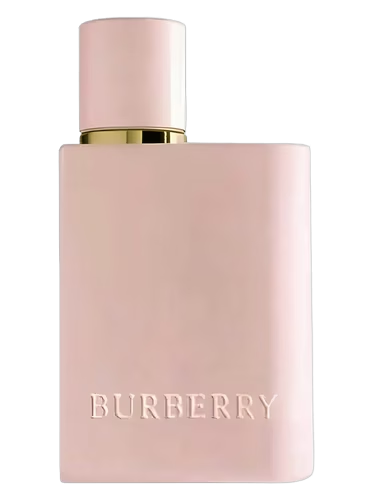
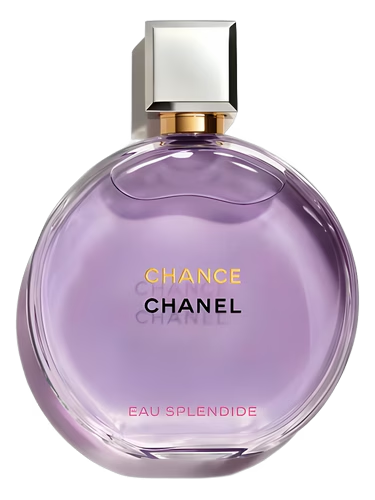
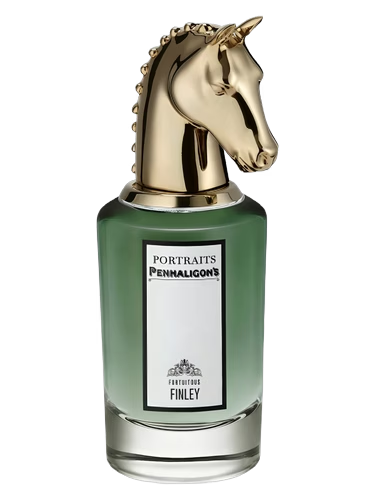
Most Popular Scents Using Alpinia
What is Alpinia?
Alpinia, commonly known as Galangal, is a tropical perennial related to ginger and turmeric, valued in modern perfumery for its aromatic rhizome.What does Alpinia smell like?
It offers a bright, spicy, and camphoraceous aroma with distinct green and woody facets, often providing a fresh, slightly medicinal quality.How is Alpinia essence extracted?
The essence is primarily obtained through distillation of the rhizomes, though traditional methods like maceration and modern techniques like supercritical fluid extraction are also used.What are some top perfumes featuring Alpinia?
Notable fragrances include Yves Saint Laurent Opium Pour Homme, Bvlgari BLV Pour Homme, Comme des Garçons Black, and Carner Barcelona Sweet William.When is Alpinia in season?
As a tropical evergreen, it exhibits peak activity during warm, humid months, with blooming typically occurring from July through September.