Fragrance Notes Are Layers Of Scent That Are Layered To Form The Final Fragrance. Fragrance Notes Are Categorised Into Three Main Elements Based On How Long They Take To Evaporate, And How Long They Typically Last Following Application: Top Notes, Heart Notes And Base Notes.
Alba Rose
Alba Rose offers a soft, delicate, and ethereal floral profile, distinct from the deep red rose. It presents a clean, powdery sweetness with subtle green-woody and honeyed nuances. Often described as innocent and sophisticated, it imparts a luminous, gentle freshness and classic elegance to compositions.

Origin & Extraction Of Alba Rose
The Alba Rose, or White Rose, represents one of the oldest classifications of cultivated roses, known historically as 'The White Rose of York.' Originating before the 15th century, its delicate, cool, and clean fragrance profile made it a celebrated symbol of purity and innocence. Unlike the richer, more opulent damask or centifolia roses, Alba Rose has historically been difficult to distill commercially, meaning its use in early perfumery often relied on enfleurage or the blending of other floral oils to recreate its ethereal scent. Its significance was largely symbolic and artistic in early European fragrance traditions, often associated with light, aristocratic, and gentle compositions.
In modern perfumery, Alba Rose is highly valued for providing a soft, non-cloying rose note that contrasts with heavy red rose absolutes. Advances in headspace technology and synthetic reconstruction allow perfumers to capture its distinct characteristics—a powdery sweetness with subtle honey and green facets—more accurately. It is now featured in contemporary fragrances to lend a luminous, gentle freshness and classic elegance, often appearing in sophisticated floral-musks and sheer, transparent compositions where the goal is refinement rather than dramatic intensity.
Extraction Methods of Alba Rose
The extraction of Alba Rose essence historically relies on delicate, manual processes to preserve its light, honeyed aroma. The most traditional method is enfleurage, where fresh petals are placed on glass plates coated with fat to absorb the fragrance, a process repeated until the fat is saturated. This was largely superseded by steam distillation of fresh petals to produce rose otto (essential oil) and rose water. Because Alba Rose contains roughly half the essential oil of the Damask rose, these traditional methods yield a precious but expensive product.
Modern industrial extraction primarily utilizes solvent extraction to produce a waxy concrete, which is then refined with alcohol into an absolute. This method is more efficient for large-scale production and is often preferred by perfumers for capturing a scent closer to the living flower. Recent advancements have introduced eco-friendly "green" technologies, such as subcritical water extraction and the use of liquefied gases like freon R134a. Additionally, supercritical CO2 extraction has become a premium standard, utilizing high pressure to capture a broader range of aromatic molecules without the use of harsh chemical solvents, resulting in a thick, creamy extract that accurately reflects the true white rose profile.
Alba Rose, prized for its soft, delicate, and ethereal scent, is utilized by modern perfumers to introduce a clean, luminous elegance that differs significantly from heavier rose absolutes. It often appears in compositions seeking sophistication and purity. A clear example of a fragrance centering on this note is Rose Alba by Alexandre.J, which pairs the soft rose heart with juicy plum and peach skin top notes, giving it a sensual yet light and fresh opening.
- Other contemporary fragrances featuring Alba Rose include Aura Alba by Natura and Wind Rose by Agonist, demonstrating the note's versatility in creating fresh, clean, and often unisex compositions.
Because the Alba Rose historically represented purity and was challenging to distill, its modern presence often relies on reconstruction and blending to capture its unique clean, powdery sweetness and subtle green-woody nuances. This refinement makes it ideal for sophisticated floral-musks and sheer, transparent scents where the focus is on gentle freshness rather than opulent intensity, ensuring the fragrance maintains a classic, aristocratic feel.
Sustainability Of Alba Rose
Sustainability of Alba Rose
- Promoting biodiversity by providing accessible pollen for bees, butterflies, hoverflies, and other beneficial insects
- Supporting natural ecosystem health through the cultivation of disease-resistant and hardy species that require minimal chemical intervention
- Implementing water-conservative gardening practices by utilizing well-drained soil and organic mulching to retain moisture
- Utilizing peat-free compost for soil enrichment to protect peatland habitats and reduce environmental impact
- Providing a natural winter food source for local bird populations through the development of nutrient-rich rose hips
Trivia
The Alba Rose, known as the White Rose of York, is believed by some experts to be the "archetypal" white rose depicted in Botticelli's Renaissance masterpiece, The Birth of Venus.
Most Popular Scents Using Alba Rose
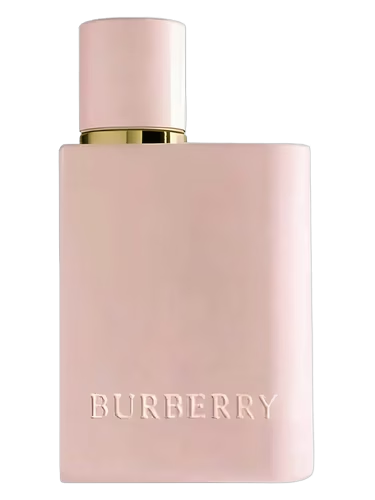
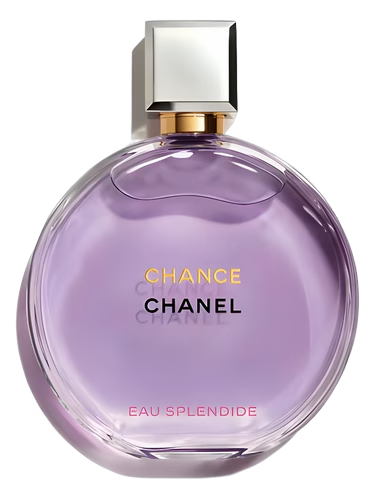
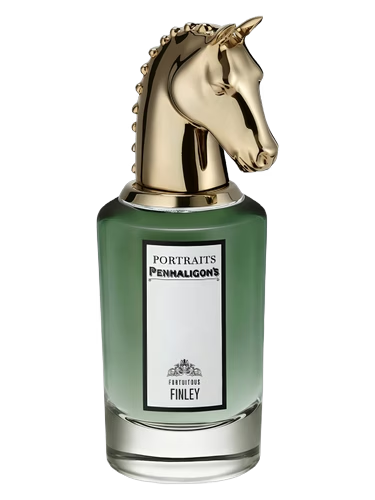
What is Alba Rose?
Alba Rose, also known as the White Rose of York, is one of the oldest classifications of cultivated roses and is historically celebrated as a symbol of purity and innocence.What does Alba Rose smell like?
It offers a soft, ethereal floral profile characterized by a clean, powdery sweetness with subtle honeyed nuances and light green-woody facets.How is Alba Rose essence extracted?
Modern essence is primarily obtained through solvent extraction to create an absolute or supercritical CO2 extraction, though traditional methods included enfleurage and steam distillation.What are some top perfumes featuring Alba Rose?
Notable fragrances include Alexandre.J Rose Alba, Natura Aura Alba, Agonist Wind Rose, and Initio Parfums Prives Atomic Rose.When is Alba Rose in season?
The Alba Rose typically blooms once a year during a profuse flush from late spring to mid-summer, generally between May and July.