Fragrance Notes Are Layers Of Scent That Are Layered To Form The Final Fragrance. Fragrance Notes Are Categorised Into Three Main Elements Based On How Long They Take To Evaporate, And How Long They Typically Last Following Application: Top Notes, Heart Notes And Base Notes.
Aglaia
Aglaia odorata offers a complex, delicate, and highly sought-after floral note. It blends creamy, narcotic-sweet floral facets, reminiscent of osmanthus and gardenia, with distinct fruity-green nuances, often leaning toward apricot or peach skin. It provides a luminous, exotic, and sensual aroma.

Origin & Extraction Of Aglaia
Aglaia odorata, commonly known as the Chinese Perfume Plant or Chinese Rice Flower, originates in Southeast Asia and has a long history of use in traditional Asian cultures. While many parts of the plant were used medicinally, the tiny, sweet-scented flowers were historically prized for their fragrance, often dried and used to perfume clothes or mixed into items like cigarettes. This early use highlights the plant's natural aromatic appeal, particularly its delicate, creamy-sweet floral scent with fruity nuances.
The incorporation of Aglaia as a distinct note in Western fine perfumery is relatively modern, following a trend of utilizing exotic and complex floral ingredients. It is appreciated today for its unique profile, which often draws comparisons to osmanthus due to its narcotic-sweet, apricot-like facets. Modern perfumers use Aglaia to lend a luminous, exotic, and sensual aroma to compositions, reflecting its status as a highly sought-after, yet delicate, floral note.
Extraction Methods of Aglaia
Historically, the aromatic compounds and active principles of Aglaia species, particularly Aglaia odorata (known as Chinese Rice Flower), were obtained through traditional maceration and air-layering techniques. These methods involved soaking dried or fresh plant parts, such as leaves and twigs, in solvents like ethanol or methanol for extended periods to capture the volatile oils. Traditional preparation often required air-drying plant materials for several weeks before grounding them into a fine powder for solvent extraction.
Modern commercial and scientific production utilizes more advanced and efficient techniques to obtain high-quality concretes and essential oils. Current standard methods include Ultrasound-Assisted Extraction (UAE), Microwave-Assisted Extraction (MAE), and Heated Reflux Extraction (HRE), which offer higher yields and more precise control over the volatile profiles. Furthermore, sophisticated processes like Headspace Solid-Phase Microextraction (HS-SPME) coupled with Gas Chromatography-Mass Spectrometry (GC-MS) are now employed to accurately characterize and isolate delicate floral and citrus-like aromatic compounds.
Aglaia, a note cherished for its creamy, narcotic-sweet floral facets often likened to osmanthus and apricot, is primarily featured in niche perfumery where its delicate complexity can be highlighted. One notable fragrance that utilizes this unique profile is Slumberhouse's **Pear & Olive** (2012). In this composition, Aglaia contributes a luminous, exotic floral depth that complements the fruity and green aspects of the scent, offering a sophisticated and unusual take on a gourmand-floral blend.
- Aglaia is appreciated for lending exotic and sensual undertones to fragrances.
Other artisanal houses have embraced Aglaia to provide nuanced sweetness and brightness. For instance, Santi Burgas features the note in **New York City** (2018), where it helps to convey a sophisticated, slightly fruity floral heart. House of Matriarch also uses the note in **Bonsai** (2019) and **Trillium** (2015), demonstrating its versatility in supporting both woody and green compositions, reinforcing its position as a high-quality, complex floral ingredient in contemporary perfumery.
- Its distinct fruity-green nuances, often leaning toward apricot or peach skin, make it a complex alternative to more traditional floral notes.
The note's close resemblance to osmanthus means it is often paired with tea or clean citrus notes to maximize its luminous quality. Providence Perfume Co.'s **Osmanthus Oolong** (2009) is an example where Aglaia facets are used to enhance the natural apricot-like scent of osmanthus, creating a richer, sweeter, and more elaborate floral-tea experience. This usage cements Aglaia's reputation as a prized, delicate component essential for crafting luminous and uniquely exotic fragrances.
Sustainability Of Aglaia
Sustainability of Aglaia
- Promoting biodiversity enhancement by utilizing the plant in ecological restoration projects to create microhabitats and support local pollinators
- Implementing organic pest management strategies by utilizing the plant’s natural insecticidal and antimicrobial properties as a bio-herbicide
- Supporting soil conservation through the use of its stabilizing root systems to prevent erosion in tropical and subtropical forest ecosystems
- Advancing pharmaceutical research into sustainable healthcare solutions by studying its unique secondary metabolites for potential cancer treatments
- Encouraging traditional ethnobotanical preservation by supporting local economies that utilize the dried flowers in artisanal tea and perfume production
Trivia
In Chinese culture, the tiny flowers of Aglaia are believed to bring wealth and good luck because their small, golden-yellow shape resembles grains of rice.
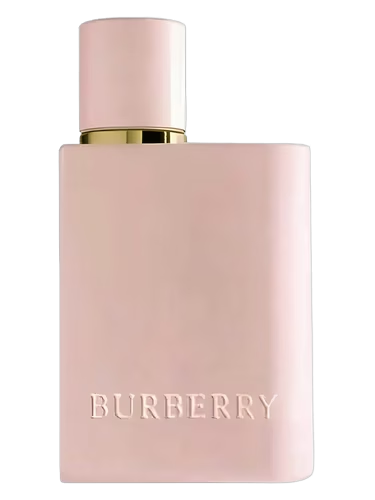
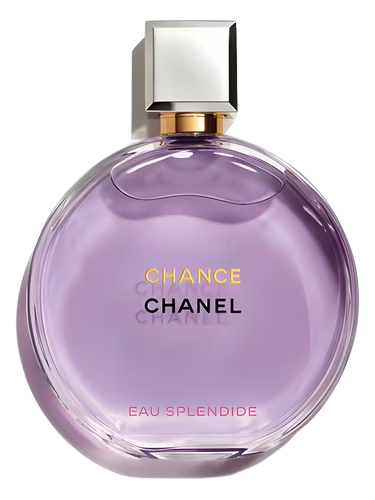
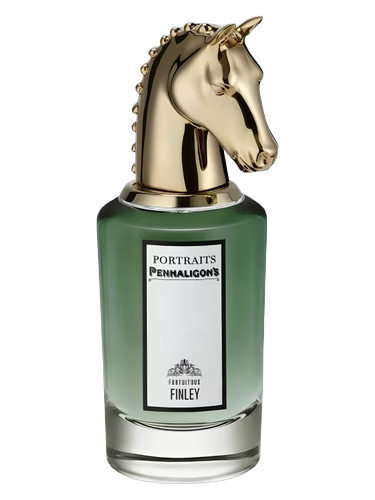
Most Popular Scents Using Aglaia
What is Aglaia?
Aglaia odorata, also known as the Chinese Rice Flower, is a species of evergreen tree native to Southeast Asia prized for its delicate, sweet-scented flowers used in fine perfumery.What does Aglaia smell like?
It features a complex, luminous aroma that blends creamy, narcotic-sweet floral facets with distinct fruity-green nuances reminiscent of apricot or peach skin.How is Aglaia essence extracted?
In modern perfumery, high-quality concretes and oils are primarily obtained through advanced solvent extraction methods like Ultrasound-Assisted Extraction (UAE) and Microwave-Assisted Extraction (MAE).What are some top perfumes featuring Aglaia?
Notable fragrances include Slumberhouse Pear & Olive, Santi Burgas New York City, House of Matriarch Bonsai, and Providence Perfume Co. Osmanthus Oolong.When is Aglaia in season?
Aglaia is a versatile evergreen that blooms on and off throughout the year in tropical climates, with its most active growth phase typically occurring from late spring through early autumn.