Fragrance Notes Are Layers Of Scent That Are Layered To Form The Final Fragrance. Fragrance Notes Are Categorised Into Three Main Elements Based On How Long They Take To Evaporate, And How Long They Typically Last Following Application: Top Notes, Heart Notes And Base Notes.
African Marigold
African Marigold offers an intense, highly aromatic, and slightly metallic green-herbaceous profile. It features a bright, complex blend of crushed green leaves, sweet, warm floral facets, and subtle fruity/spicy undertones. This note provides a unique, vibrant, and bittersweet complexity often used to introduce a sharp, naturalistic top-to-heart greenness.

Origin & Extraction Of African Marigold
African Marigold, often referred to by its Latin name *Tagetes minuta* or simply Tagetes, has a history in perfumery that is distinct from the classical notes. Native to the Americas, it was introduced to Africa, Europe, and Asia where it became naturalized. Historically, the plant was valued in traditional cultures for its medicinal properties and its use as a natural dye. Its oil, known for its intense green and slightly metallic-spicy aroma, was not a staple in early European perfumery, which favored ingredients like civet, rose, and classic Mediterranean citruses. Its complex scent profile, which bridges green notes, light florals, and subtle fruity/spicy facets, meant it remained largely an auxiliary or specialty ingredient for much of the 19th and early 20th centuries.
The significance of African Marigold in modern perfumery grew with the rise of photorealistic and nature-inspired compositions in the mid-to-late 20th century. Perfumers began seeking materials that could lend an authentic, sometimes challenging, green-herbaceous structure. Tagetes essential oil provides a potent and unique signature, valued for introducing a sharp, naturalistic greenness at the top and heart of a fragrance. It is often used sparingly, as its intensity can be dominating, but it is crucial for imparting bittersweet complexity and a vibrant, warm quality, particularly in modern chypre and aromatic fougère compositions.
Extraction Methods of African Marigold
Historically, African marigold (Tagetes erecta) extracts were obtained through simple aqueous decoctions or "tea brewing" methods, where dried petals were steeped in boiling water to release dyes for textiles or medicinal uses. Traditional industrial techniques evolved into solvent extraction, typically using hexane or ethanol to produce marigold oleoresin. Another classic method involves the use of mordants like alum or ferrous sulfate to stabilize the dyes for cotton and silk coloration.
Modern extraction methods have advanced significantly to improve purity and sustainability. Supercritical CO2 extraction is now widely used to produce high-purity lutein and essential oils without toxic solvent residues. Other innovative "non-conventional" techniques include ultrasound-assisted extraction (UAE) and microwave-assisted extraction, which reduce processing time and enhance the yield of bioactive compounds. Additionally, enzymatic pretreatments using cellulase and hemicellulase are employed to break down plant cell walls before mechanical pressing or solvent application to optimize pigment recovery.
African Marigold, or Tagetes, is often employed in contemporary perfumery to lend a unique, bittersweet green-herbaceous complexity. It offers a profile that is both sharp and subtly warm, bridging bright citrus openings with aromatic hearts. Its use signifies a modern approach to freshness, moving beyond traditional floral or green notes to introduce a vibrant, naturalistic texture.
- One of the most famous and successful uses of African Marigold is in Byredo's **Bal d'Afrique**. In this fragrance, the marigold note is central, providing a luminous, energetic opening that complements notes of bergamot and neroli, contributing to its signature warmth and complexity. The marigold provides the bittersweet quality that grounds the fragrance's sophisticated, exotic character.
Beyond highly celebrated contemporary launches, Tagetes is also featured in modern niche compositions to create unique twists on established fragrance genres. Because of its intensity, it is often dosed carefully to ensure it adds structure and depth without dominating the entire scent, particularly in chypre and aromatic fougère compositions. The resulting effect is a sophisticated, slightly metallic greenness that enhances longevity and adds an unexpected, complex floral-spice facet.
Sustainability Of African Marigold
Sustainability of African Marigold
- Promoting organic gardening and reducing reliance on chemical pesticides by utilizing the plant's natural scent and compounds to repel pests like aphids, whiteflies, and cabbage moths
- Improving soil health and biodiversity through the suppression of soil-borne nematode populations and the attraction of beneficial insects and pollinators
- Advancing water conservation and climate resilience by adopting precision irrigation methods and researching the viable reuse of treated wastewater for cultivation
- Supporting circular economy principles by repurposing plant biomass as green manure or organic compost to enhance soil structure and fertility
- Enhancing rural economic livelihoods and social sustainability by providing a versatile, high-demand crop for medicinal, industrial, and ornamental applications
Trivia
Despite its name, the African Marigold is actually native to Mexico and Central America; it earned the "African" label because it was first introduced to Europe via trade routes passing through northwest Africa.
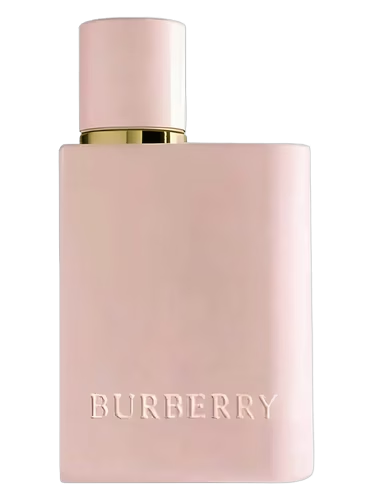
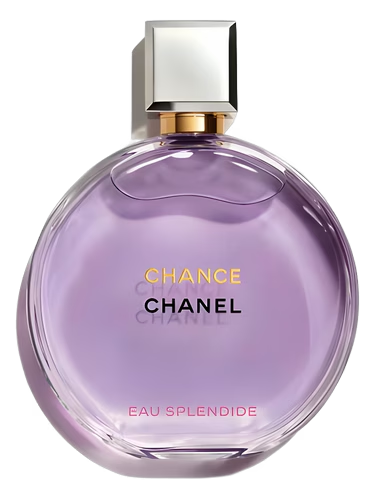
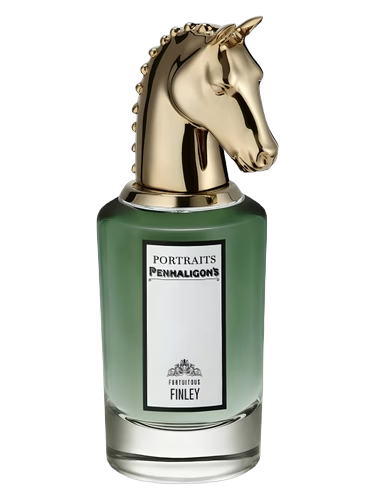
Most Popular Scents Using African Marigold
What is African Marigold?
African Marigold, also known as Tagetes, is a plant native to Mexico and Central America valued in perfumery for its intense green-herbaceous oil.What does African Marigold smell like?
It features a bright, complex profile of crushed green leaves and sweet floral facets with a unique, bittersweet and slightly metallic greenness.How is African Marigold essence extracted?
The essence is primarily obtained through distillation or modern supercritical CO2 extraction to ensure high purity and capture its delicate aromatic profile.What are some top perfumes featuring African Marigold?
Notable fragrances include Byredo Bal d'Afrique, Kajal Lamar, The Merchant of Venice Red Potion, and Boadicea the Victorious Blue Sapphire.When is African Marigold in season?
They are warm-season annuals that typically bloom from early summer through the first frost of autumn, peaking in beauty from midsummer to late fall.