Fragrance Notes Are Layers Of Scent That Are Layered To Form The Final Fragrance. Fragrance Notes Are Categorised Into Three Main Elements Based On How Long They Take To Evaporate, And How Long They Typically Last Following Application: Top Notes, Heart Notes And Base Notes.
Acacia
Acacia offers a delicate, honeyed floral scent, reminiscent of clean, sun-warmed pollen. It is subtly sweet, slightly powdery, and often carries a fresh, green, and slightly almond-like nuance. Its fragrance gently envelops the senses, evoking springtime and natural freshness, perfect for light, serene compositions.

Origin & Extraction Of Acacia
The history of Acacia in perfumery, sometimes referred to by its botanical names such as Mimosa (specifically *Acacia dealbata*), is tied to its use as an elegant, natural floral material, primarily in the South of France and North Africa. While it lacks the ancient, foundational status of notes like rose or jasmine, the use of its absolute gained prominence in the late 19th and early 20th centuries. It was prized for its distinctive, delicate, honeyed scent, which provided a sweet, powdery, and slightly almond-like nuance to compositions, often serving as a sophisticated, yet gentle, heart note in classic floral bouquets.
In modern perfumery, Acacia remains a cherished, though less dominant, floral note. It is typically used to evoke a sense of springtime, softness, and natural freshness. Perfumers employ Acacia to add subtle sweetness and texture, contrasting brighter top notes or smoothing out heavy bases. Its delicate, pollen-like aroma is particularly valued in soft, serene compositions and often features in fragrances that aim to replicate the smell of a sun-drenched landscape or a highly realistic natural bouquet.
Extraction Methods of Acacia
Historically, acacia extracts were obtained through traditional manual methods such as simple maceration, where plant materials like bark or leaves were soaked in water or alcohol for extended periods to dissolve active compounds. Acid-base extraction was also common for research purposes, involving the acidification of powdered bark with vinegar or organic acids, followed by basification with lye to release and collect alkaloids using non-polar solvents. Steam distillation has also been a traditional standard, particularly for capturing essential oils from the flowers of specific species.
Modern commercial and scientific extraction has evolved to utilize more advanced and efficient techniques. Current methods include supercritical fluid extraction (SFE) using carbon dioxide (CO2), which allows for high purity at near room temperatures, and ultrasound-assisted or microwave-assisted extraction to increase efficiency and reduce solvent use. High-purity protocols often employ modern mechanical grinders and high-speed centrifuges to separate aqueous phases, while advanced chromatography and mass spectrometry are used to verify the concentration and purity of the resulting extracts.
Acacia, often used interchangeably with Mimosa in perfumery, lends a distinctive, soft, and powdery sweetness to floral compositions. One of the most classic and celebrated fragrances to feature this note prominently is Champs-Élysées by Guerlain. This fragrance masterfully utilizes the delicate, honeyed scent of the acacia flower to create a bright, optimistic, and luminous opening that evokes the feeling of strolling through Parisian boulevards in springtime. The inclusion of acacia helps balance richer floral notes, offering an airy, refined texture.
- Champs-Élysées by Guerlain
In contemporary perfumery, the Acacia/Mimosa note is frequently utilized in high-end and niche scents aiming for a highly realistic, natural floral effect, moving beyond traditional heavy white flowers. A modern interpretation is found in Jo Malone London’s Mimosa & Cardamom, which pairs the creamy, powdery sweetness of acacia (mimosa) with the sharp, warm spice of cardamom. This combination highlights the delicate, sun-warmed pollen facet of the note, creating a comforting yet exotic aura that demonstrates acacia's versatility beyond classic floral bouquets.
- Mimosa & Cardamom by Jo Malone London
Acacia is also a cherished component in fragrances designed to evoke soft, yellow-hued florals and powdery textures, providing depth and a slight almond-like sweetness that ensures a gentle drydown. When used as a supporting note, as in the formulation of various classic floral structures, acacia contributes a subtle complexity that prevents the scent from becoming too sharp or green. Its honeyed quality is essential for rounding out the heart of a fragrance, adding an element of comforting, sophisticated elegance to both designer and artisanal creations.
Sustainability Of Acacia
Sustainability of Acacia
- Promoting carbon sequestration by utilizing acacia trees as carbon sinks that absorb significant amounts of CO2 during their fast-growing lifespan
- Enhancing soil health and biodiversity through the species' nitrogen-fixing capabilities, which enrich poor soils and support reforestation and land restoration efforts
- Adopting water-efficient and low-impact cultivation practices, as acacia thrives in arid conditions with minimal water, synthetic fertilizers, or pesticides
- Supporting a circular economy by utilizing the multipurpose nature of the tree, repurposing wood waste into by-products and harvesting renewable gums and oils without clearing natural forests
- Establishing collaborative and ethical sourcing programs, such as the SOS SAHEL initiative, to ensure fair socio-economic conditions and sustainable land management for local communities
- Implementing certified sustainable forestry standards, such as FSC, to ensure responsible harvesting and prevent the depletion of rare or endangered timber species
Trivia
In Egyptian mythology, the acacia tree was revered as the Tree of Life, specifically linked to the myth of Osiris and Isis as a symbol of resurrection and immortality.
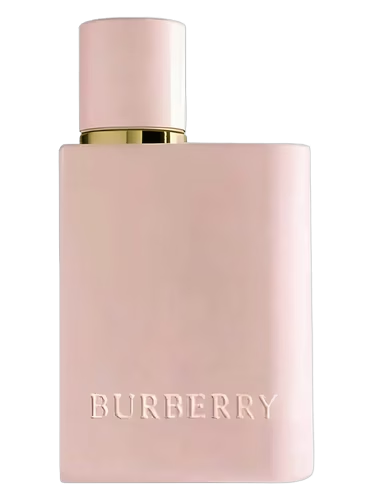
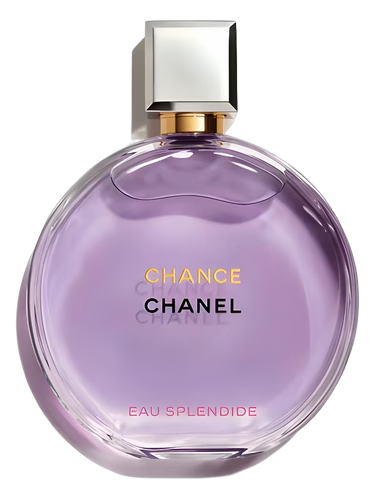
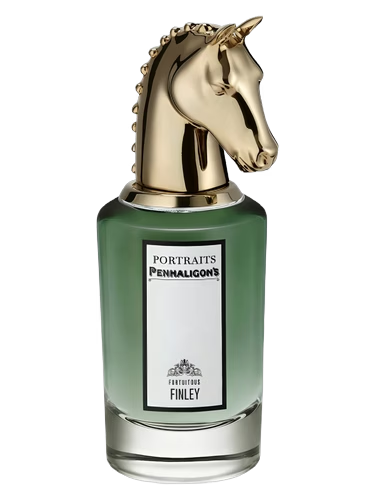
Most Popular Scents Using Acacia
What is Acacia?
Acacia, often referred to as Mimosa in perfumery, is a delicate floral note derived from trees native to regions like Australia and Africa, prized for its natural, springtime aroma.What does Acacia smell like?
It offers a soft, honeyed, and slightly powdery scent with fresh green facets and a subtle almond-like sweetness reminiscent of sun-warmed pollen.How is Acacia essence extracted?
In modern perfumery, high-purity extracts are obtained using advanced methods like supercritical CO2 extraction, though historically it was produced through maceration or steam distillation.What are some top perfumes featuring Acacia?
Notable fragrances include Guerlain Champs-Élysées, Jo Malone London Mimosa & Cardamom, Clive Christian 1872 Twist Acacia, and Caron Farnesiana.When is Acacia in season?
The primary blooming period for Acacia occurs in late winter and early spring, typically between January and April, when its fragrant golden-yellow flowers are most abundant.