Fragrance Notes Are Layers Of Scent That Are Layered To Form The Final Fragrance. Fragrance Notes Are Categorised Into Three Main Elements Based On How Long They Take To Evaporate, And How Long They Typically Last Following Application: Top Notes, Heart Notes And Base Notes.
Abelia
A bright, vibrant, and highly refreshing profile, characterized by sharp, zesty, and effervescent notes like sparkling lemon, tart lime, and sweet mandarin. It delivers an immediate, uplifting burst of clean energy, often incorporating aromatic green or subtle floral undertones. Ideal for top notes and classic Eau de Cologne structures.

Origin & Extraction Of Abelia
Abelia, a plant native to East Asia, particularly China and Japan, has a history rooted in ornamental gardening and association with tranquility due to its serene appearance and delicate fragrance. While the flower itself has been cherished for centuries in Asian cultures, its introduction and use as a distinct, isolated note in Western fine perfumery are considerably more recent. The note is generally an accord designed to capture the plant's bright, fresh, and subtly floral scent, often incorporating zesty and green undertones.
As a specific note, Abelia is utilized in modern perfumery to contribute a vibrant, highly refreshing profile, balancing sharp, sparkling citrus notes with underlying floral nuances. Because Abelia does not possess the long-standing historical presence of foundational notes like Bergamot or Lemon, its use is typically found in contemporary compositions seeking a unique, uplifting burst of clean energy, often integrated into modern "fresh" or floral-citrus structures.
Extraction Methods of Abelia
Historically, the aromatic properties of Abelia have been captured through traditional herbal techniques such as simple infusion and maceration. These methods involve steeping the aerial parts—leaves, stems, and flowers—in solvents like alcohol or carrier oils for several weeks to create tinctures and scented oils. Additionally, traditional hydro-distillation using a Clevenger-type apparatus has long been the standard for isolating the plant's essential oils, a process that involves boiling the plant material in water to release volatile compounds through steam.
In modern phytochemical research, the extraction of Abelia is primarily performed using advanced hydro-distillation followed by Gas Chromatography-Mass Spectrometry (GC-MS) to identify and quantify its diverse chemical constituents, such as scutellarein and caffeic acid. Recent scientific developments also utilize sophisticated laboratory techniques including capillary electrophoresis with diode array detection and electrospray quadrupole-time-of-flight mass spectrometry to achieve high precision and sensitivity in characterizing the plant's bioactive profiles. For larger-scale botanical study, exhaustive extraction with 95% ethanol followed by vacuum evaporation and solvent partitioning is used to isolate specific compounds like bis-iridoid glucosides.
The Abelia note, being a relatively modern and specialized accord in fine perfumery, is not associated with historical masterpieces but rather with contemporary niche and designer compositions seeking a bright, highly refreshing, and subtly floral profile. Perfumes that feature Abelia often aim for an airy, uplifting freshness that transcends the standard citrus-floral opening, integrating zesty and luminous facets. This note serves to inject clean energy, making it a sophisticated choice for modern transparent fragrances.
- Abelia is sometimes rumored to be an unpublished component in popular modern fresh scents like certain flankers of **Dior J'adore** or lighter variations of **Gucci Bloom**, lending a crisp, green lift to the dominant white florals.
- Niche houses exploring unique floral-citrus blends are more likely to formally list the Abelia note. For instance, specific artisanal perfumes aiming to capture an East Asian garden serenity, such as those from brands like **Jo Malone** (in limited editions) or **L'Artisan Parfumeur**, occasionally employ accords to mimic the bright, delicate scent of the Abelia flower.
Due to its association with delicate tranquility and its subtle, complex scent profile (blending sharp citrus with underlying floral nuances), the Abelia note is particularly valued in high-end, contemporary perfumery where transparency and nuance are prioritized over heavy longevity. It often appears in compositions categorized as "fresh," "green," or "floral-citrus," contributing an element of sophisticated brightness.
- Blooming typically begins in late spring or early summer and continues consistently through the first frost, often spanning from May to October
- New foliage growth emerges in early spring, frequently displaying bright red, bronze, or yellow tints depending on the variety
- Foliage undergoes dramatic transitions in autumn and winter, shifting to vibrant shades of orange, fiery red, or purplish-bronze as temperatures drop
- The plant provides year-round interest as an evergreen or semi-evergreen shrub, though it may experience winter dieback or become deciduous in colder climates
- Pruning is ideally performed in late winter or early spring before the first flush of growth to shape the plant and encourage blooms on new wood
Sustainability Of Abelia
Sustainability of Abelia
- Promoting water conservation through the use of drought-tolerant and "water-wise" varieties that can thrive on natural precipitation once established
- Supporting urban biodiversity by planting nectar-rich, tubular flowers that attract and provide food for essential pollinators, including bees, butterflies, and hummingbirds
- Reducing the need for chemical interventions due to the plant's natural resistance to major pests, diseases, and deer grazing
- Utilizing low-maintenance shrubs that require minimal pruning and supplemental watering, thereby lowering the environmental footprint of landscape management
- Implementing erosion control on slopes and hillsides by utilizing the plant's stabilizing root systems and dense, mounding growth habit
- Advancing ecological health by promoting non-invasive Abelia cultivars as sustainable alternatives to invasive exotic shrub species
Trivia
The Abelia is so closely related to honeysuckles and viburnum that it can mimic their sweet scent, and one rare variety, Abelia mosanensis, is so exceptionally cold-hardy that it was first introduced to the West by a Latvian woman who used botanical Latin to bypass a three-language barrier.
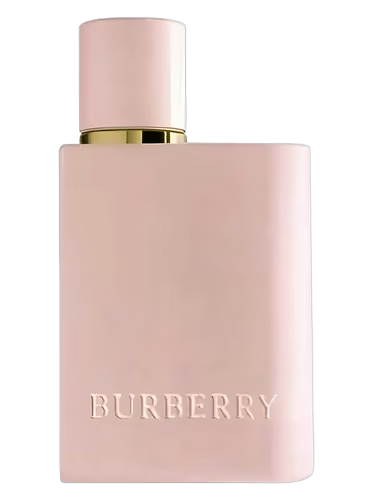
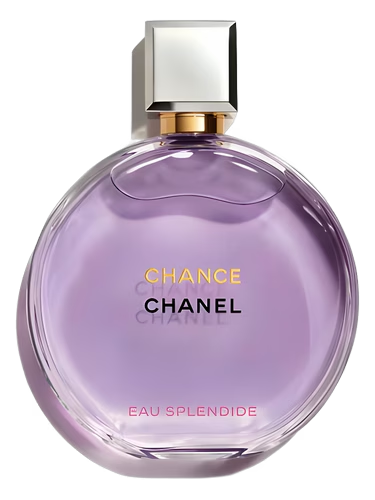
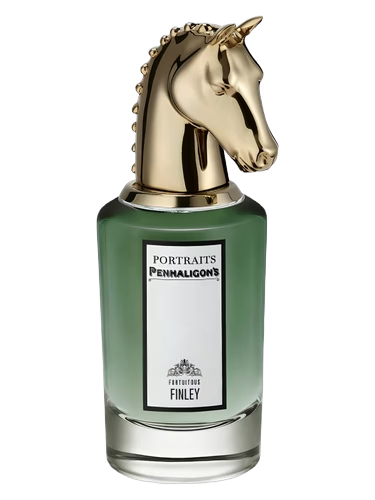
Most Popular Scents Using Abelia
What is Abelia?
Abelia is a genus of flowering shrubs native to East Asia, known for its delicate, tubular blossoms and its modern use as a refreshing, subtly floral accord in contemporary perfumery.What does Abelia smell like?
It offers a bright, vibrant profile featuring zesty citrus notes like lemon and lime blended with soft, honeyed floral nuances and fresh green undertones.How is Abelia essence extracted?
In fine perfumery, the Abelia note is typically a synthetic reconstruction or accord, as it is not commonly extracted on a commercial scale from the plant itself.What are some top perfumes featuring Abelia?
Fragrances that utilize or evoke the Abelia note include Van Cleef & Arpels California Reverie, Perris Monte Carlo Jasmin de Pays, and Recreation This Love of Mine.When is Abelia in season?
The plant typically blooms from late spring through early summer and can continue until the first frost, often spanning from May to October.